
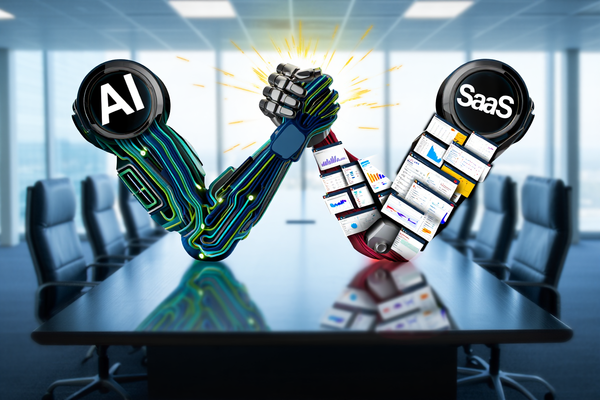
As a scenario that AI will replace enterprise software, dubbed “SaaSpocalypse” — the end of SaaS — gains traction, the pushback from established software companies is intensifying.
Major software companies are going beyond launching AI agent platforms and are actively rebutting the limitations of the SaaSpocalypse narrative.
Salesforce announced the “Salesforce Headless 360” platform optimised for AI agents.
Headless 360 supports AI agents in directly calling and executing the full set of Salesforce platform functions through APIs, MCP tools and command-line interface (CLI) commands, without a person opening a screen and clicking. Previously, using the Salesforce platform required a person to access it through a web browser and click through screens. Headless 360 removes the screen.
VentureBeat reported that, with Headless 360, Salesforce answered “no” to the question of whether a graphic UI-based CRM is still needed in an environment where AI agents can reason, plan and execute.
According to the Wall Street Journal, Salesforce also plans to unveil by this year a new AI platform codenamed “Agent Albert”. Agent Albert is focused on having AI automatically analyse users and act on their behalf.
Salesforce shares are down 28 percent so far this year amid the AI-driven threat narrative. Salesforce has also been active in rebutting the SaaSpocalypse narrative.
According to the WSJ, Salesforce CEO Marc Benioff said, “AI makes Salesforce more valuable to customers than ever,” adding, “AI companies will not be able to replace what Salesforce provides even if they want to. They will work with Salesforce.”
On the scenario that companies can build their own sales management software through vibe coding, he pointed out, “It is not easy to build something that can compete with Salesforce in core functions such as security and compliance.” Benioff said, “People think we are cornered, but in fact the opportunity is bigger than ever,” expressing confidence.
ServiceNow CEO Bill McDermott (빌 맥더멋) has also publicly pointed out that SaaSpocalypse is exaggerated.
Appearing recently on the podcast “no priors”, he rebutted the “SaaSpocalypse” narrative spreading among companies and warned that “simply using language models to replicate existing enterprise platforms would cost more than 10 times as much as using existing platforms because of building GPU factories and token costs.”
Many companies are enthusiastic about large language models (LLMs), but his argument is that what creates real business value is not the model itself but the “workflow” that puts it into action.
While rebutting the SaaSpocalypse narrative, ServiceNow is also accelerating a shift in its product strategy to focus on AI agents. ServiceNow aims to provide an “AI native architecture” that embeds agent automation functions across services, platforms and products.
Creative software company Adobe has also recently announced its AI agent platform CX Enterprise and begun deploying AI agents across the board.
Adobe also introduced Adobe CX Enterprise Coworker, an AI agent that completes tasks independently.
Adobe CEO Shantanu Narayen said, “It is clear that new AI-centred applications will emerge, and business models will change accordingly.” Amit Ahuja, senior vice president in charge of Adobe’s customer experience orchestration products, said, “CX Enterprise is a very big step forward that clearly shows how Adobe technology is being used in the AI era.”
Adobe shares are down about 30 percent so far this year, and attention is on whether its AI agent strategy can turn the mood around.
 Chi-gyu Hwang
delight@d-today.co.kr
Chi-gyu Hwang
delight@d-today.co.kr