
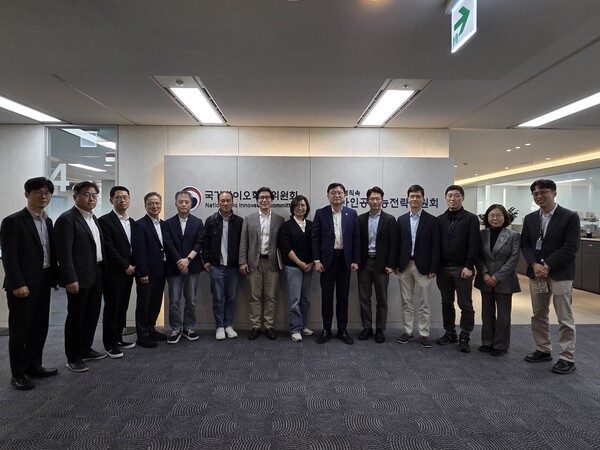
South Korea's National Artificial Intelligence Strategy Committee has set up new subcommittees on autonomous driving and humanoids to expand industrial artificial intelligence transition (AX). The move aims to step up efforts to foster related industries as AI enters an era of "physical AI" that combines with the physical world beyond the digital environment.
The committee said on Monday it established an "Autonomous Driving Subcommittee" and a "Humanoid Subcommittee" under its Industrial AX and Ecosystem division and held first kickoff meetings for each.
It explained it has started discussions on key agendas to implement the national AI action plan, as autonomous driving mobility and humanoid robots emerge as core pillars of global industrial competitiveness.
The autonomous driving subcommittee was formed with 12 members, led by Soo-young Kim (김수영), an executive director at Hyundai Motor. The humanoid subcommittee was formed with 14 members, led by Byung-tak Jang (장병탁), a professor at Seoul National University. Members from the existing Industrial AX and Ecosystem and Technology Innovation and Infrastructure divisions, as well as industry experts, also participated.
At the autonomous driving subcommittee, the Ministry of Land, Infrastructure and Transport reported on the status of its autonomous driving demonstration projects and its future plans. Members discussed ways to operate pilot driving zones to secure data and build infrastructure in real road environments, as well as advancement strategies.
In particular, an opinion was raised that to speed up commercialisation of autonomous driving, demonstration projects in public transport and logistics should be expanded and institutional improvements, such as safety guidelines aligned with the introduction of autonomous driving agents, should proceed in parallel.
Kim said, "Autonomous driving is a key industry that changes the mobility paradigm and a concentration of AI technologies." He added, "Through advancing demonstration projects that reflect voices from the field and proactive regulatory innovation, we will lay the foundation for domestic autonomous driving technology to lead the global market."
At the humanoid subcommittee, Yun-seok Pyo (표윤석), a vice president at Robotis, presented on humanoid robot market trends, the global competitive landscape and domestic response strategies. The Ministry of Trade, Industry and Energy then reported on a draft plan on creating and expanding a humanoid industry ecosystem.
The draft plan includes strengthening technological capabilities, building foundations for industrial development, supporting company growth and strengthening the industrial support system. Members reviewed the potential for domestic companies to adopt humanoids in manufacturing and service sites as competition among global companies including Tesla and AgeBot intensifies, and said stronger manufacturing competitiveness is needed.
Jang said, "Humanoids are the crystallisation of 'physical AI', in which AI has a physical entity, beyond being simple robots." He said, "We will pool public and private sector capabilities so that Korea can leap forward as a hub of the global humanoid ecosystem by carrying out without setbacks the policy tasks included in the national AI action plan."
Each subcommittee plans to hold regular meetings twice a month to review the status of implementation of action plans by ministry and key issues. The committee plans to support the spread of industrial AX from autonomous driving to humanoids by reflecting creative ideas from the private sector in policy.
 Seulgi Son
sageson@d-today.co.kr
Seulgi Son
sageson@d-today.co.kr