
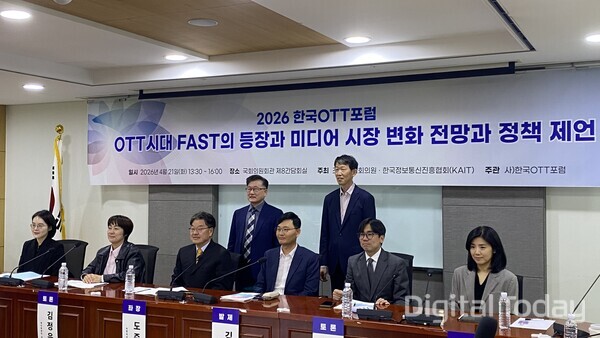
A proposal has emerged to use smart TVs from Samsung and LG deployed worldwide as global distribution infrastructure for K-content. As plans for a “homegrown OTT” to combine domestic online video services such as Tving and Wavve into a single platform for overseas expansion drift, free ad-supported streaming TV, or FAST, is taking shape as an alternative.
Kim Jeong-seop (김정섭), a professor in the Department of Cultural Industry and Arts at Sungshin Women's University, said at a “FAST policy discussion forum in the OTT era” held at the National Assembly Members' Office Building in Yeouido on April 21 that licensed broadcasting and telecommunications businesses are structurally bound to remain domestic. For broadcast content to go global, it must ride on existing smart TV networks, he said.
FAST is a streaming model that provides content funded by advertising without a separate subscription fee. It comes preinstalled on smart TVs from Samsung and LG and can be used without additional installation. The global FAST market is expected to reach $12 billion in 2027, market research firm Omdia said. A KOBACO report projected the domestic market could also grow to 1.21 trillion won by 2028.
Korean home appliance makers lead the global smart TV market. Samsung Electronics currently provides about 3,000 channels and about 50,000 VOD titles in 27 countries through Samsung TV Plus. LG Electronics operates more than 3,800 channels in 29 countries through LG Channels. Kim said Korean smart TVs have a 45 percent share globally, which translates into 2 billion to 2.5 billion households. Netflix has 300 million subscribers, and there is no need to sell new land with such infrastructure in place, he said.
He added that Samsung and LG are too quiet and passive in South Korea. He said more than 100 people at Samsung Electronics' Suwon site are all-in on the FAST business, indicating they already know it makes money. They are quietly generating profits, he added.
As the broader domestic media industry slumps, FAST is growing its presence through targeted advertising. Domestic OTT services are stuck in a loss-making structure due to limits of the subscription model and surging content costs. Terrestrial broadcasters are seeing advertising revenue fall, while cable and IPTV are losing subscribers. Unlike Netflix buy-out contracts that transfer comprehensive rights in a lump sum, FAST shares advertising revenue with platforms, enabling reuse of existing IP and securing second and third streams of revenue.
FAST, meanwhile, has strengths of both traditional broadcast ads and digital advertising. It tracks in real time what content viewers watch and how they watch it, and uses programmatic methods, or real-time automated ad auctions, to send ads matched to preferences. That makes its targeting more efficient than traditional broadcast advertising.
Kwon Ye-ji (권예지), a researcher at the Korea Broadcast Advertising Corp (KOBACO), said what matters is not which content people watch but how they watch it and how the data is used. Devices, platforms and data need to be considered together, she said.
Commerce-linked advertising is also drawing attention. Kwon said FAST has a strong character as global infrastructure that South Korea can build and can be used as an advertising export infrastructure linking other industries such as K-beauty, food, health and medical services, as well as commerce. Kim Jeong-eun (김정은), CEO of K2NT, also said viewing data and ad-efficiency data can be provided simultaneously through K-content channels. Running ads on K-FAST channels would have a far higher marketing effect than the Korea Tourism Organization pushing targeting ads on global media, she said.
Groundwork is also being laid for U.S. distribution of K-content. KOBACO signed an MOU with U.S. media group Sinclair on March 17. Sinclair is a terrestrial-focused media group that has 185 TV stations and 640 channels across the United States. The two sides are pursuing efforts to expand distribution of Korean broadcasting, media and content in the U.S. market and to support advertising entry. Kwon said a plan is needed to link overseas marketing support projects with FAST, but that part is currently missing.
From the perspective of content investment, IP monetisation through FAST is also being mentioned as a breakthrough. Some point out, however, that initial investment funds cannot rely only on public budgets. Kim said the cultural budget is only 7 trillion won, and even combining Korea Venture Investment under the Ministry of SMEs and Startups and Korea Growth Finance under the Financial Services Commission amounts to about 8 trillion won. The industry needs to consider how to draw 4,000 trillion won in private funds in the market into domestic content, he said. Without cultural finance, it will be difficult for both FAST and OTT to succeed, he added.
On-the-ground conditions are not easy. Kim Jeong-eun, CEO of K2NT, said the company operates five global FAST channels, including K-movies, K-beauty and K-food, but currently has no profit at all. The biggest hurdles are dubbing and subtitles, she said. To take past content global, subtitle processing costs more than production costs, but no one supports it, leaving many titles buried, she said. That means that unlike policy discussions about global expansion, the actual business operators' revenue model has not yet been established.
INTER-MINISTRY SILOS, MUTUAL EXCLUSION: K-FAST POLICY GAP PERSISTS
Policy support must underpin efforts to foster FAST, the discussion said. Kim proposed setting a win-win standard that gives Samsung and LG both incentives and obligations. The mutual exclusion issue in which LG Channels cannot be watched on Samsung smart TVs and Samsung TV Plus cannot be watched on LG TVs should be resolved through a notice from the Ministry of Science and ICT, he said.
Support for content localisation is also key. Noh Chang-hee (노창희), head of the Digital Industry Policy Research Institute, said FAST should be promoted rather than regulated. Since K-content has grown within the pay-TV ecosystem, there needs to be consideration of how that ecosystem can remain healthy while co-growing with a new medium such as FAST, he said. He added that government investment at some scale could deliver results in a few areas, including remakes that cover subtitles and dubbing and further reversioning support that optimises content by country.
The need for an integrated control tower to oversee FAST policy and promotion has also been raised. FAST is currently overseen by three ministries: the Ministry of Science and ICT for tech and infrastructure, the Ministry of Culture, Sports and Tourism for content, and the Korea Communications Commission for legal systems. Kim said the three ministries are working together but there are tense areas and many difficulties. He said a control tower is needed that can coordinate under the direct authority of Cheong Wa Dae.
 Seul-gi Son
sageson@d-today.co.kr
Seul-gi Son
sageson@d-today.co.kr