
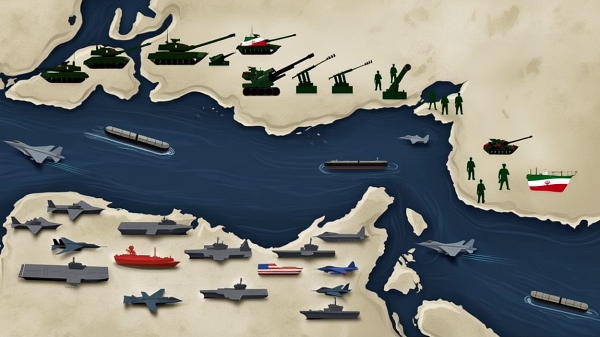
The impact of the Trump-Iran war has removed more than 500 million barrels from global oil supply in about seven weeks, causing losses worth more than $50 billion in crude value.
On April 19, local time, blockchain outlet Cryptopolitan reported that the shock began in late February and has continued until now. It said it could take months to years to restore supply chains.
The disruption is shaking prices, storage and overall trade flows, beyond a simple drop in volume. Kpler data show the volumes unable to reach the market included crude and condensate. Market analysts view it as the largest supply shock in the modern energy market.
Markets have also offered comparisons to illustrate the scale. Five hundred million barrels equals 10 weeks of global aviation demand, about 1 month of U.S. demand and more than 1 month of European demand. Ian Mowat of Wood Mackenzie explained the figure by linking it to actual consumption.
Oil price risks remain focused on the Strait of Hormuz. Iran's Foreign Minister Abbas Araqchi said on April 18, after a ceasefire agreement, that the strait was open. U.S. President Donald Trump said an agreement to end the war could be reached soon, but did not provide a specific timeline. With uncertainty remaining, markets are again watching the possibility of a renewed closure.
In prediction markets, the chance that U.S. oil prices will top $100 a barrel this month if Iran blocks the Strait of Hormuz again is priced at 44 percent. On April 19, Trump claimed Iran tried to pressure the United States with a threat to reclose the strait, saying, "Iran tried to be a bit crafty." He added, "They tried to close the strait again, but they cannot threaten the United States."
Some transit through the strait has resumed. Ship-tracking data showed five LNG vessels departing Qatar's Ras Laffan moving toward the Strait of Hormuz. If these vessels pass through, it would be the first LNG transport to transit the strait since the war broke out on Feb. 28. Iran reopened the route on April 18 after a U.S.-brokered Israel-Lebanon ceasefire, and on April 19 a fleet of oil tankers also began transiting the strait.
But reopening the strait does not mean a return to normal. Before the war, the Strait of Hormuz was a key energy artery that handled about one-fifth of global LNG trade volume. Qatar is the world's No. 2 LNG exporter, but its export capacity has fallen 17 percent due to the attacks. Another projection said annual supply of 12.8 million tonnes could be removed from the market for 3 to 5 years due to the impact of restoration work.
Oil inventories and production disruptions are already visible in the data. Kpler said global onshore crude inventories fell by about 45 million barrels in April. Since late March, the scale of production disruptions has reached about 12 million barrels a day.
Heavy crude oil fields in Kuwait and Iraq are expected to take 4 to 5 months to recover normal output. With damage to refineries and the Ras Laffan LNG complex adding to the strain, supply tightening may continue through this summer. A full recovery of the wider Middle East energy system could take years.
 Jinju Hong
hongjj@d-today.co.kr
Jinju Hong
hongjj@d-today.co.kr