
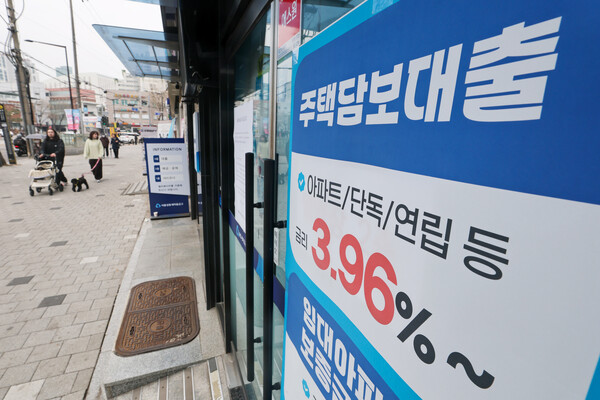
As mortgage loan rules tighten across the board, end users are facing an emergency in raising funds. Some borrowers are being told their loans are not possible from the consultation stage at bank branches. Some are turning to "yeongkkeul"—pulling in everything they can—to fill gaps with credit loans. The market is also raising concerns that this trend could distort the structure of household debt itself.
The financial sector said on April 20 that the loan market is rapidly freezing as the authorities’ tough household debt management policy takes full effect. Regulations have been strengthened, including limits on extending maturities for mortgage loans held by multiple-home owners. Banks have moved to manage overall lending volumes, and the impact is spreading to loans for end users.
As banks raise the bar, loan demand has shifted to mutual finance lenders, but that channel is also being blocked. Saemaul Geumgo decided to fully suspend new mortgage lending to non-members. Regional agricultural cooperatives and credit unions are also restricting loans to non-members, focusing on cooperatives with high household loan growth rates.
Savings banks are also being bound by strict volume caps, and overall lending capacity across non-bank financial institutions is shrinking rapidly.
After some savings banks expanded lending while exceeding their household loan management targets, the financial authorities notified at least 3 savings banks of measures to cap this year’s household loan growth rate at 0 percent. As a result, those savings banks can make new loans only within the scope of loans repaid at maturity. That effectively prevents them from increasing their loan books any further.
The financial authorities said they applied sanctions focusing on cases that indiscriminately expanded general credit loans and secured loans. The move is seen as aimed at blocking a balloon effect caused by tighter bank regulations. Of the 3.5 trillion won increase in household loans across the financial sector last month, about 2.7 trillion won came from mutual finance lenders, accounting for 77 percent.
The problem is that this "loan shutdown" is becoming a direct burden for end users.
Mutual finance lenders and savings banks have served as the de facto last funding window for mid- to low-credit borrowers pushed out of commercial banks. With that now blocked, end users such as buyers who must prepare move-in balance payments and low-income households needing living expenses are being driven to the edge. In the financial sector, some are also raising the possibility that certain borrowers could be pushed into high-interest private lending.
◆Mortgages down, credit loans up... concerns over deterioration in the "quality" of household debt
Concerns are also growing because loan demand is not disappearing but shifting into other forms. As mortgage lending is blocked, the move to raise funds through credit loans is becoming clear.
The financial authorities said last month’s household loans across the financial sector rose 3.5 trillion won, with the increase widening from the previous month. Growth in mortgage loans slowed, but other loans including credit loans shifted from a decrease to an increase, pushing up overall growth.
In the banking sector in particular, banks’ own mortgage loans fell while credit loans rebounded, leading the increase in household loans. The structure is changing so that higher-interest credit loans are expanding in place of secured loans.
End users preparing to buy homes say banks appear reluctant to handle mortgage lending itself from the consultation stage at branches. Critics say the burden is growing as borrowers have little choice but to resort to "yeongkkeul" to fill funding gaps, including raising funds through credit loans.
The financial authorities have warned that volatility in household loans could increase and have also signaled additional regulations. They also cite external variables, including the end of a suspension of heavier capital gains taxes for multiple-home owners and Middle East-related risks, as factors increasing market uncertainty.
The industry is focusing on the point that the recent tough stance on household debt management may ultimately be effective in controlling the overall size of household debt, but could also lead to a "qualitative deterioration".
A financial sector official said, "In the process of curbing loans, the financing environment for end users is deteriorating rapidly." The official added, "If mortgages are blocked and even non-bank financial institutions are shut off, the structure leaves no choice but to move to other loans with even higher interest rates."
 Ji-young Lee (이지영)
ljy@d-today.co.kr
Ji-young Lee (이지영)
ljy@d-today.co.kr