
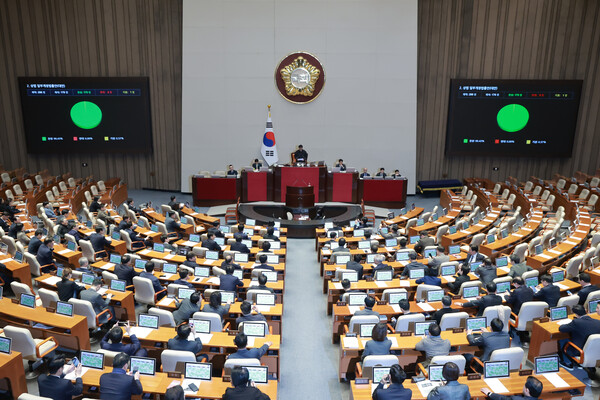
A bill to mandate the principle of cancelling treasury shares held by companies cleared the final hurdle in parliament on Tuesday, led by the Democratic Party.
The National Assembly passed the bill, known as the third round of Commercial Act revisions, at a plenary session that day.
The amendment, pushed by the Democratic Party as legislation to improve the structure of the financial and capital markets, centers on making it a principle that companies cancel treasury shares within 1 year of acquiring them.
Exceptions apply when certain reasons are recognized, such as employee compensation or operating an employee stock ownership plan, and when a holding and disposal plan signed and sealed by all directors is approved at the annual general meeting of shareholders each year.
For companies where foreign investment is restricted under the Telecommunications Business Act and other laws, the bill requires them, in principle, to dispose of treasury shares within 3 years of the effective date to the extent necessary to comply with relevant laws.
When the bill was placed on the plenary agenda the previous day, the People Power Party responded immediately with a filibuster, a lawful obstruction of proceedings through unlimited debate.
The People Power Party opposed the bill, saying domestic companies could be exposed to hostile attacks by so-called corporate raiders.
After the filibuster ended 24 hours later following a motion to end debate by the Democratic Party and other ruling-bloc parties, the bill passed the plenary session after a vote.
A bill on the crime of distorting the law, a revision to the Criminal Act and one of three so-called judicial reform bills pushed by the Democratic Party, was then immediately placed on the plenary agenda.
The bill centers on punishing judges, prosecutors and others with up to 10 years in prison and up to 10 years of suspension of qualifications if they distort the law in trials or investigations with the aim of unlawfully benefiting others or harming their rights and interests.
The Democratic Party revised part of the content immediately before the bill was introduced. The move is seen as responding to criticism within and outside the party that the abstract nature of some provisions could lead to controversy over unconstitutionality.
The original draft defined acts of "distorting the law" in three ways: intentionally misinterpreting laws and regulations to disadvantage or advantage a party; destroying, concealing, forging or altering evidence in a case, or using evidence while knowing it has been forged or altered; and unlawfully collecting evidence through assault, intimidation or deception, acknowledging criminal facts without evidence, or recognizing facts in a manner that markedly runs counter to logic or rules of experience.
Floor spokesperson Baek Seung-a (백승아) said it was revised "in a direction that adds clarity to each item and minimizes potential grounds for unconstitutionality."
The scope of cases subject to the crime of distorting the law will also be limited to criminal cases, excluding civil and administrative cases.
The revised bill also includes content expanding the scope of the espionage offense from the existing "enemy state" to "a foreign country or an organization equivalent to it."
The People Power Party again began a filibuster, protesting that the crime of distorting the law is a "bad law" that undermines the judicial system.
Accordingly, the bill is expected to be put to a vote on the afternoon of Feb. 26, after 24 hours have passed since the start of the filibuster and after the Democratic Party and other ruling-bloc parties move to end debate.
Other judicial reform bills, including legislation to introduce a constitutional complaint against court rulings and a plan to increase the number of Supreme Court justices, are also expected to be handled sequentially in the same way.
[Yonhap News Agency]
 Online Team
d-today@d-today.co.kr
Online Team
d-today@d-today.co.kr