
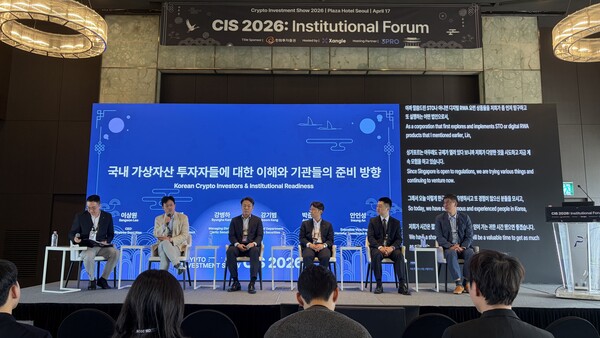
Korean financial firms see the digital asset market as next-generation financial infrastructure, but again stressed that urgent regulatory overhaul is needed for a full-scale entry.
At CIS2026 held at the Plaza Hotel in Seoul on April 17, institutional investors pointed to regulatory gaps and custody, compliance and risk management systems as obstacles to expanding the digital asset market.
Choi Young-jin (최영진), a vice president at Hanwha Asset Management, pointed out that the digital asset market has grown for more than 10 years, but South Korea has not properly set out the scope of investable underlying assets and market rules.
Choi also stressed that the digital asset market should no longer remain a market only for individuals, saying participation by companies and financial institutions would allow the market to grow in a healthier way.
Kang Byung-ha (강병하), a managing director at Meritz Securities, cited regulatory uncertainty and the challenge of persuading internal organisations as barriers felt by the securities industry. He pointed out that it is not clear which players can provide which assets and to whom, and that legislation and internal control systems still need to be refined.
He said concerns are particularly high within IT and compliance teams about how to integrate traditional financial systems with decentralised ledgers and how to address consumer protection issues.
Park Jun-ha (박준하), chief technology officer at Toss Bank, said the banking sector also sees regulatory gaps as the biggest problem. He said institutional participation is possible only after the roles and responsibility structure are defined, including who bears what responsibility when an incident occurs.
He assessed that global examples have already accumulated in terms of technology and infrastructure. He said Korean financial firms can also speed up preparations quickly if regulations are put in place.
Ahn In-sung (안인성), a vice president at Hanwha Investment & Securities, suggested tokenised securities and real-world assets (RWA) as areas the financial sector can pursue immediately. He said they should be seen as a process of digitising products, and explained they can complement liquidity and small-investment limitations of existing private-placement and real estate products.
Kang Ki-beom (강기범), head of digital new business at Hana Securities, said irregular assets in the form of fractional investment are the most quickly accessible field. He introduced that Hana Securities is carrying out work to structure actual products in preparation for the opening of markets for investment contract securities and tokenised securities.
A view was also offered that institutional demand is already substantial. Choi said demand from institutional investors was behind the expansion of the digital asset exchange-traded fund (ETF) market in the United States, and that Korean institutions are also reviewing digital asset investment as part of asset allocation but are blocked by the system.
He said discussions on incorporating digital assets could become inevitable from the perspective of pensions and long-term asset allocation. He also raised concerns that the domestic financial sector could miss opportunities the longer market opening is delayed.
The importance of risk management and compliance was also stressed. Kang explained that blockchain transactions are irreversible, making them hard to roll back when incidents occur, and that designing delegated authority and emergency response systems is important in a 24-hour operating environment.
He also said new anti-money laundering (AML) issues arise because the source and movement routes of funds crossing borders must be verified, adding that banks, securities firms and asset managers should respond together.
Panelists also cited the spread of stablecoins as a key variable. Choi said dollar-based stablecoins are likely to spread quickly as a means of payment and store of value, and stressed that South Korea should put its systems and market structure in place before it is too late.
 Oh Sang-yup
yub@d-today.co.kr
Oh Sang-yup
yub@d-today.co.kr