
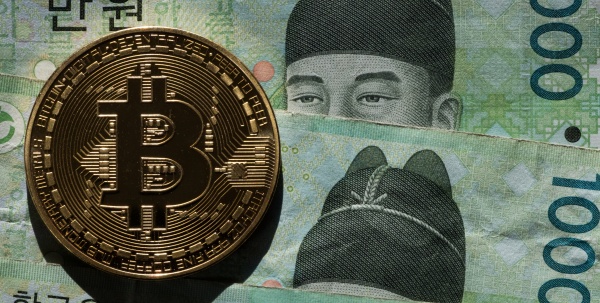
[Digital Today reporter Jinju Hong (홍진주)] South Korea is re-emerging in the global cryptocurrency market as an altcoin-centred trading hub. Unlike overseas markets where trading is dominated by bitcoin (BTC) and ether (ETH), domestic exchanges show a clear trend of altcoins driving price formation and liquidity.
Cryptopolitan, a blockchain media outlet, reported on Tuesday that South Korean exchanges account for about 30 percent of global cryptocurrency trading volume. It said about 85 percent of that volume is concentrated in altcoin trading.
The structure contrasts with major overseas exchanges. On exchanges with a high share of U.S. investors, such as Coinbase, bitcoin and ether pairs account for about 70 percent of total volume. In South Korea, the share of bitcoin was 9 percent and ether about 6 percent.
A feature of the South Korean market stems from its won-based trading structure. Domestic exchanges such as Upbit and Bithumb operate mainly around won markets, creating conditions in which independent liquidity forms in specific altcoins separate from global capital flows.
Weekly trading volume on South Korean exchanges is about $2.66 billion, limiting overall scale, but there are confirmed cases in which trading concentrated in specific tokens affects global derivatives markets. By comparison, Binance’s share of altcoin trading was about 30 percent over the same period, making the concentration in South Korea more pronounced.
A representative case is Enjin Coin (ENJ). ENJ was recently among the top-traded assets on Bithumb, and more than 20 percent of its total volume came from won trading pairs. As its price set new highs during that period, open interest (OI) also jumped to its highest level in 3 years.
XRP and Zama (ZAMA), which has seen an increase in recent trading, were also cited as cases influenced by the South Korean market. For both assets, derivatives-market OI surged as trading increased on domestic exchanges. The direction set in the spot market spread to global derivatives markets.
Still, overseas exchanges remain the centre of the derivatives market. Even for tokens that are actively traded on South Korean exchanges, futures liquidity mostly relies on global platforms such as Binance. Foreign investors are participating by checking price moves in the South Korean market and then responding in the derivatives market.
South Korea also limits direct access by overseas investors due to bank regulations. Even so, international market participants are trading indirectly using Binance or perpetual futures platforms. Some older altcoins lack perpetual futures products, meaning strength in South Korea’s spot market does not always lead directly to an expansion in global derivatives trading.
Across Asia, trading volume has fallen to a lower level than in the past. Even so, South Korea remains an exceptional market by maintaining altcoin-centred trading. Japan is assessed as a market that provides relatively stable bitcoin liquidity of $20 billion to $30 billion a week, but it has not shown an altcoin-heavy structure like South Korea.
Ultimately, the South Korean market is operating with liquidity concentrated in certain altcoins rather than across the overall cryptocurrency market. Among these tokens, assets with clear volume and direction are affecting not only the spot market but also global derivatives markets, leading to analysis that South Korea still serves as a starting point for altcoin price formation.
 Jinju Hong
hongjj@d-today.co.kr
Jinju Hong
hongjj@d-today.co.kr