
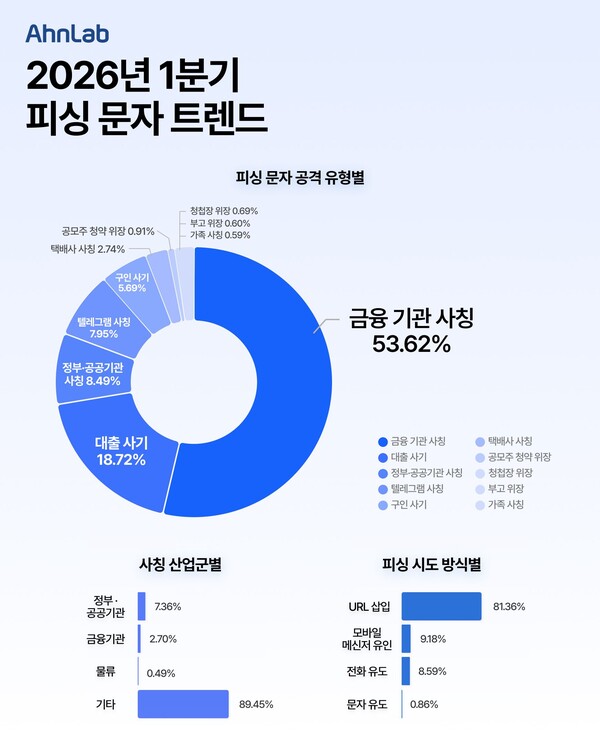
AhnLab released its “Q1 2026 Phishing Text Message Trends Report”, which includes results from detecting and analysing various phishing texts using its agentic AI security platform, “AhnLab AI PLUS”, from January to March 2026.
The most common type of phishing text attack in the first quarter, as in the previous quarter, was “financial institution impersonation”, accounting for 53.62 percent of the total. It was followed by loan scams (18.72 percent), government and public institution impersonation (8.49 percent), Telegram impersonation (7.95 percent), job scam (5.69 percent), delivery company impersonation (2.74 percent), fake IPO subscriptions (0.91 percent), fake wedding invitations (0.69 percent), fake obituary notices (0.60 percent) and family member impersonation (0.59 percent).
Financial institution impersonation and loan scam types rose 9.38 percent and 205.15 percent, respectively, from the previous quarter, posting sharp increases. Government and public institution impersonation and Telegram impersonation showed the biggest declines, at 51.99 percent and 22.55 percent, respectively. AhnLab analysed the shift as indicating that attackers are targeting finance and lending, where they can realistically expect higher returns.
The most common phishing approach was “URL insertion”, accounting for 81.36 percent of the total. It was followed by luring victims to mobile messengers (9.18 percent), prompting calls (8.59 percent) and prompting text replies (0.86 percent).
AhnLab said, “Phishing text trends in the first quarter showed a flow similar to the previous quarter, confirming that attackers are focusing on refining methods with proven success rates rather than new tactics.” It added, “In May, Family Month, various phishing attempts are expected to increase by exploiting timing factors such as major commemorative days and long holidays, so people should develop a habit of checking once more without feeling at ease even with familiar phishing types such as fake wedding invitations and family member impersonation.”
 Chi-gyu Hwang
delight@d-today.co.kr
Chi-gyu Hwang
delight@d-today.co.kr