
Three out of four game industry workers feel job insecurity due to the introduction of AI, but formal labour-management talks on the issue take place at only one in four workplaces, a survey showed.
Expectations that tax credits, a key benefit in the proposed amendment to the game industry law, would translate into better treatment stood at only 37 percent. Support for the policy direction and distrust of the implementation structure ran in parallel, and frontline workers formally called on the Democratic Party to form a standing tripartite consultative body.
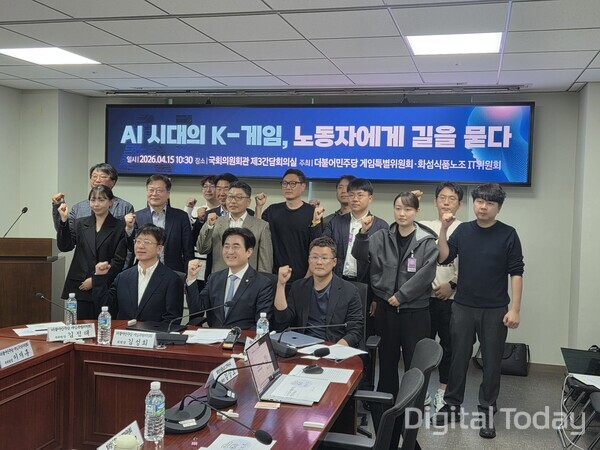
The Democratic Party's Game Special Committee and the IT committee of the Korean Chemical, Textile and Food Industry Workers' Union, or Hwa-seom IT committee, held a policy meeting on April 15 at the National Assembly Members' Office Building under the theme, "K-games in the AI era: asking workers for the way forward."
The meeting was arranged to review how a full revision of the game industry law being discussed in parliament affects development sites and to discuss institutional supplements needed during the AI transition. The revision redefines games from a regulated target to a promoted industry, and includes the outsourcing of rating classification to the private sector, the creation of a game promotion agency and tax credits for production costs as key elements.
Democratic Party members of the game special committee and labour union representatives from major South Korean game companies attended.
Support tops 90 percent, awareness 12 percent; "Not sure benefits will reach workplaces"
In the first presentation, Kim Sang-ho (김상호), head of Nexon's union branch, released results of a survey of 1,078 frontline workers at game union branches under the Hwa-seom IT committee. Support for policy direction was high, with 94.5 percent backing tax credits for game production costs, 93.1 percent supporting legislation related to AI and 91.3 percent favouring the establishment of a game promotion agency. But only 12 to 16 percent said they knew the details of each policy.
The numbers behind that were more stark. Only 37.3 percent expected the tax credit benefits to lead to better treatment or job retention. This reflected distrust over whether tax support would go beyond improving corporate finances and be returned to workers. On the creation of a game promotion agency, 80.8 percent said labour unions should participate. This meant they wanted an operating structure that reflects workplace views rather than simply a new institution.
In the AI survey, tensions in the field appeared in the numbers. Some 65.6 percent said they already use AI frequently at work, and 80.3 percent said they feel productivity has improved. About 85 percent of respondents said changes driven by AI have already begun or will accelerate in earnest within a few months. But 77.3 percent said they feel job insecurity, and 82.3 percent said guidelines for profit sharing are needed. Only 26.7 percent said formal talks on AI are taking place between companies and labour unions. Some 64 percent also said it is difficult or impossible to design fair incentive standards based on AI contribution.
Kim said, "The AI issue has already shifted beyond productivity to job security, protection of creators' rights and fair distribution of results," adding, "Industrial promotion and labour protection are not a matter of choice, but tasks that must go together."
"Now is the golden time"; restore trust through a tripartite consultative body
In the second presentation, Noh Young-ho (노영호), head of Webzen's union branch and a member of the Democratic Party game special committee's industry promotion subcommittee, described the current period as the golden time for K-games, while presenting the restoration of trust as a precondition. He proposed building an institutional structure as a way to address workplace anxiety confirmed by the survey.
The Hwa-seom IT committee formally urged the creation of a standing tripartite consultative body. Its main argument was that policy acceptance will rise if the views of frontline workers are directly reflected in the bill's design process. It also argued that, while AI is already used across the game development process, frontline developers know best which stages use it and how, so labour, management and government should jointly create standard guidelines. It added that a regular consultation structure should be established before gaps between management and developers over the direction of AI use spill into actual conflict.
The discussion also raised limits of a structure centred on big-company unions. Oh Se-yoon (오세윤), chair of the Hwa-seom IT committee, said industry-wide bargaining beyond company-by-company negotiation is needed to address job insecurity for workers at small and indie game companies without unions. He argued that, given the industry's nature as a hit-driven business with a high probability of project failure, the industry needs a safety net at the sector level so workers can try again after failure.
Song Ga-ram (송가람), head of NC's union branch, said, "Game industry workers are developers but also users and trend leaders," adding, "The industry can continue to develop only if an environment is in place where talent can work stably."
Oh said the Hwa-seom IT committee represents about 20,000 union members working in the field, and that policy acceptance could also rise when it participates in policy design, again urging the creation of a tripartite consultative body.
 Lee Ho-jung
lhj@d-today.co.kr
Lee Ho-jung
lhj@d-today.co.kr