
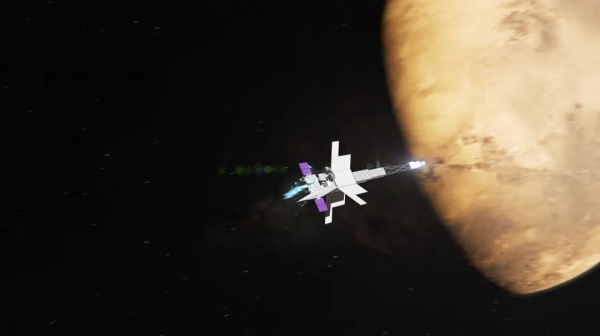
[DigitalToday reporter Jinju Hong] The U.S. space agency NASA unveiled a plan to develop its first interplanetary spacecraft powered by a reactor, SR-1 Freedom, and send it to Mars in 2028. Attention is focused on whether it will become a turning point for full-scale use of nuclear power in deep-space exploration.
On April 14 local time, MIT Technology Review reported that NASA has presented a timetable for deploying a reactor-propelled spacecraft on an actual mission, in addition to plans to build a base at the moon's south pole and install a reactor on the lunar surface.
The core of the plan is to use conventional chemical propulsion for launch from Earth and then, after entering space, use electricity generated by nuclear fission to obtain long-duration thrust. NASA Administrator Jared Isaacman (재러드 아이작먼) said the United States is beginning to use nuclear power in space, declaring the start of the first interplanetary nuclear mission.
Reactor propulsion is drawing attention because it can reduce reliance on solar power and improve efficiency for long-distance flights. Spacecraft currently move mainly with chemical propulsion using liquid hydrogen and liquid oxygen, but while that method provides strong thrust it has limits in efficiency for long-duration operations. Experts see nuclear fuel as having far higher energy density than conventional propellants, giving an advantage for traveling through the solar system for longer periods and at higher speeds.
SR-1 is expected to use nuclear electric propulsion rather than nuclear thermal propulsion. It would generate electricity from heat produced by the reactor and use it to accelerate a propellant gas. The method is seen as suitable for long-distance missions because it produces low thrust but high efficiency.
Part of the outline of the vehicle's structure has also emerged. SR-1 is likely to place the power and propulsion system at the rear and a 20-kilowatt uranium reactor at the front. Large radiators would be mounted on both sides to release heat generated during fission.
The development schedule is tight. NASA plans to begin hardware development in June, complete assembly and prepare for testing by January 2028, and target a launch later that year. The reactor is expected to be activated about two days after entering space, rather than immediately after launch, due to safety concerns.
The project is likely to use power and propulsion technology that had been intended for the existing lunar orbital station Gateway. It would combine a reactor with a solar-based system and expand it to suit the deep-space environment.
The plan also carries significance in terms of space strategy rather than markets or industry. The United States has attempted nuclear propulsion research several times in the past but halted it due to cost and safety issues. As a return to the moon and competition in deep space intensify, the priority of nuclear propulsion is rising again.
With China and Russia pushing to build a reactor on the lunar surface by 2035, the plan is interpreted as part of competition over nuclear power in deep space.
NASA plans to use data accumulated by operating a reactor in the space environment through the mission for future construction of a lunar base. If SR-1 reaches Mars as targeted, it is expected to be an important test bed for gauging the practicality of nuclear-based space propulsion systems.
 Jinju Hong
hongjj@d-today.co.kr
Jinju Hong
hongjj@d-today.co.kr