
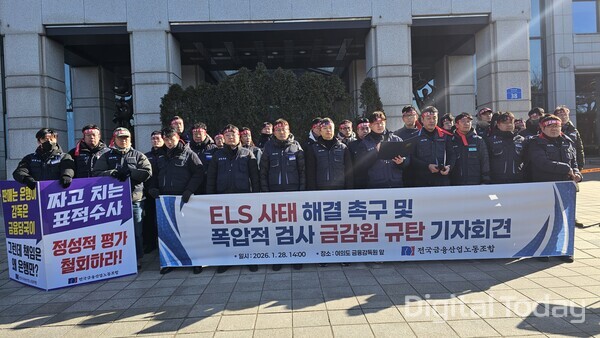
A decision on fines for banks over mis-selling of Hong Kong H-index-linked equity-linked securities (ELS) is nearing. Financial authorities have been unable to reach a conclusion for an extended period over the size of the fines, but there is speculation a decision will be made at the Financial Services Commission's regular meeting on April 15.
The Financial Services Commission will hold its regular meeting on Wednesday to discuss agenda items, the financial industry said. The industry has raised the possibility that the mis-selling case involving banks' Hong Kong ELS products will be taken up at the meeting. If no conclusion is reached again, the final decision could be pushed to next month. Still, expectations are growing that a decision will come at this meeting given that another delay could increase the burden on financial authorities.
The fine amount has already been sharply adjusted once. The Financial Supervisory Service initially calculated the sanction amount at about 4 trillion won, but it was lowered to about 1.4 trillion won after going through the sanctions review committee. Since the Financial Services Commission, which has been handed the final judgment, can grant additional reductions of up to 75 percent under the Financial Consumer Protection Act and other rules, the final fine is expected to vary widely depending on the extent of the cut.
Within the Financial Services Commission, views are reported to coexist that additional reductions are needed to reflect that banks pre-emptively compensated a substantial portion of investor losses, and that further easing should be limited because a reduction has already been made once.
Banks are strongly arguing for reductions based on their voluntary compensation performance. Major selling banks have completed compensation for about 95 to 97 percent of affected customers. Since supervisory authorities previously mentioned the possibility of easing sanctions for pre-emptive compensation, expectations are also significant that some level of reduction is inevitable. Banks also cite a recent trend in civil rulings that emphasises the principle of investor self-responsibility as a factor supporting their response logic.
Banks face fallout from fines as ELS business hangs in the balance and lawsuits are weighed
The ELS case is also forcing changes in banks' product strategies. Major commercial banks have almost halted ELS sales since late 2023, and some are reviewing full exits rather than resuming business. It reflects a combination of higher cost burdens from tighter sales rules, mis-selling risks and concerns that confirming fines could weaken capital soundness.
In particular, fines lead to capital regulation burdens beyond simple costs. If fines are confirmed, banks must reflect multiples of the amounts in risk-weighted assets (RWA) for a certain period, directly affecting capital efficiency. If they end the ELS business, they can reduce the burden of RWA reflection after a certain period, leaving them in a situation where they must review whether to continue the business depending on the fine size. At the same time, the rapid spread of simpler structured investment products such as exchange-traded funds (ETF) is also weakening the competitiveness of ELS products.
The direction of the fallout is expected to vary depending on the Financial Services Commission's final judgment. The fine level is likely to heavily influence whether banks pursue litigation and the speed of business restructuring. At the same time, how far financial authorities' consumer protection stance will be implemented is also cited as a key variable in the decision.
Ultimately, the Financial Services Commission decision is expected to go beyond confirming fines and affect banks' sales strategies for high-risk products, the supervisory direction of financial authorities and the broader financial consumer protection system.
A banking industry official said, "Whether the legal battle expands could change depending on the level of the sanctions." The official added, "A cautious response is inevitable because the size of the fine is directly linked to the justification of management decisions."
 Ji-young Lee
ljy@d-today.co.kr
Ji-young Lee
ljy@d-today.co.kr