
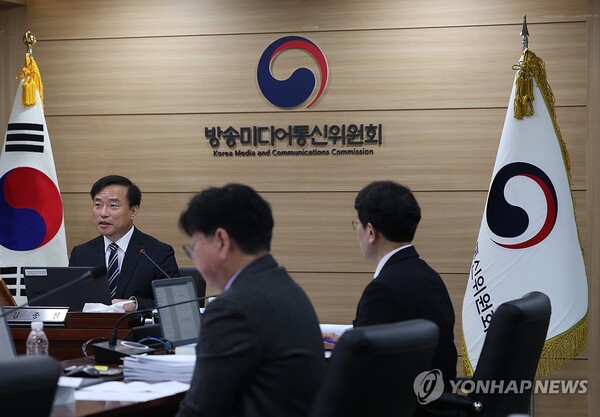
South Korea's Broadcast and Media Communications Commission held its first full meeting and began formal operations by handling key agenda items such as terrestrial broadcaster licence renewals. But the regulatory framework for over-the-top video services remains unprepared and still split across three ministries.
Under current law, OTT is classified as a "value-added telecommunications service", meaning it is not considered broadcasting. The Ministry of Science and ICT oversees platform and telecommunications areas under the Telecommunications Business Act. The Ministry of Culture, Sports and Tourism is responsible for content ratings classification and video promotion. The commission oversees broadcasting and pay TV, but OTT falls outside its remit.
That regulatory structure has not changed since the commission's launch. When the commission was set up, 33 officials were transferred from the science ministry, including staff from the Broadcasting Promotion Planning Division, the New Media Policy Division and the OTT Revitalisation Support Team, but the legal classification of OTT remained unchanged. A commission official said, "We tried to move OTT promotion work to the commission, but the science ministry kept its existing jurisdiction, so only the personnel came over and the work could not follow." The official added, "We are exploring a direction to resolve jurisdictional coordination issues between ministries through the Audiovisual Media Services Act."
The problem is that OTT is already effectively replacing broadcasting functions. It is drawing viewers by absorbing sports broadcasts, live performances and news, but remains outside the Broadcasting Act framework.
Figures also show that OTT is replacing broadcasting. According to the commission's "2025 Survey on Broadcasting Media Usage Patterns", the OTT usage rate rose to 81.8 percent in 2025 from 77.0 percent in 2023. The share of paid OTT users also increased to 65.5 percent from 57.0 percent over the same period. By contrast, the pay TV subscription rate kept falling.
As a result, concerns over regulatory fairness are emerging. Broadcasters face scheduling and advertising regulations and bear the burden of contributing to the Broadcasting Development Fund. OTT does not. They perform the same functions, but are subject to different rules. The OTT industry prefers to keep the current classification, saying applying the same regulations as broadcasting would dampen industry growth and investment.
There is also a regulatory imbalance within the OTT sector. South Korean OTT platform Tving is a subsidiary of CJ ENM, which operates tvN and OCN, among others. Wavve was launched with the three terrestrial broadcasters KBS, MBC and SBS participating as major shareholders. Legally, both platforms are value-added telecommunications service providers, but their parent companies and major shareholders are subject to Broadcasting Act regulations. The Broadcasting Act framework can indirectly affect content procurement and management decision-making. Netflix is different. With no equity stake held by South Korean broadcasters, it is a pure value-added telecommunications service provider with no point of contact with the Broadcasting Act framework. They have the same legal status, but face different practical regulatory environments.
The domestic industry points out that this leads to exclusion from promotion policies. An industry official said, "Now is the time when we need to create an environment for K-OTT's self-sustaining capabilities and global expansion." The official added, "We should focus on promotion to revitalise domestic OTT rather than regulation."
The commission plans to address structural limits by setting up a Media Development Committee under the Prime Minister's Office as a higher-level body. Its plan is to support legislation of the Audiovisual Media Services Act, a unified media law framework, to bring OTT into the same legal framework as broadcasting.
Commission Chairman Jong-cheol Kim (김종철) said at a news conference marking his first 100 days in office on March 30, "We will actively support the establishment of a tentatively named Media Development Committee under the Office for Government Policy Coordination to institutionalise social discussion and public deliberation, and make it the starting point for a major shift in media policy." He added, "Through the Media Development Committee, we plan to support integrated discussions in which regulatory and promotion policies are linked, including the legal and institutional foundation such as the Audiovisual Media Services Act that the commission is preparing, as well as the funding structure of the broadcasting media sector."
The launch schedule for the Media Development Committee has yet to be set. Legislation of the Audiovisual Media Services Act also requires prior coordination of jurisdiction with the science ministry and the culture ministry. Just as the commission held its first full meeting six months after its launch, it appears it will take considerable time to overhaul the OTT regulatory framework.
 Seul-gi Son
sageson@d-today.co.kr
Seul-gi Son
sageson@d-today.co.kr