
South Korea's digital asset market is moving away from a structure centered on simple trading and shifting toward an ecosystem focused on technical contributions and infrastructure building.
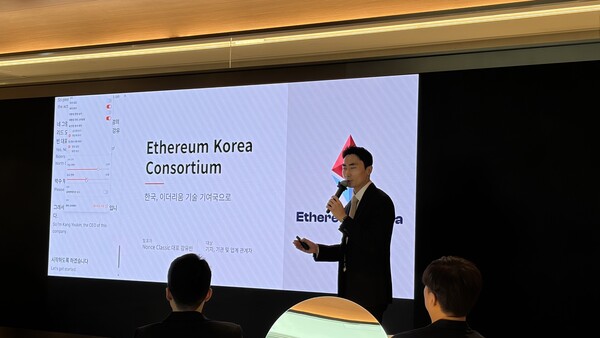
The Ethereum Korea Consortium (Ethereum Korea Consortium, EKC), launched on April 14 at Centerfield in Seoul's Gangnam district, said it will serve as a private-sector cooperation platform linking the Korean and global Ethereum ecosystems.
The consortium was formed with Web3 community builder Nonce Classic at its core. Nonce Classic's selection as a first-quarter 2026 recipient of the Ethereum Foundation's official support program, the Ecosystem Support Program, provided the impetus for the launch.
Kang Yu-bin (강유빈), CEO of Nonce Classic, said South Korea is a global top-tier trading market but its technical contribution to the protocol itself is minimal.
"We must go beyond simply consuming technology built by others and directly participate in Ethereum core development and building the technical ecosystem to expand South Korea's influence," Kang said. "EKC will function as a 'Coordination Layer' where diverse contributors coexist and generate synergy, not an exclusive structure dominated by a specific company," he added.
EKC includes 10 companies: Nonce Classic, The Ticker Is Ether, Crypto Planet, Radius, Node Infra, Sunnyside Labs, DSRV, Waybridge, Popillus and Undefined Labs.
These companies will divide responsibilities across ecosystems and community, infrastructure, institutional bridge, and media and content, based on their respective expertise.
Nonce Classic and The Ticker Is Ether will jointly lead the ecosystem and community segment, with Crypto Planet participating.
Radius, Node Infra and Sunnyside Labs joined the infrastructure segment. In the institutional bridge segment, DSRV and Waybridge, which hold virtual asset service provider licenses, will participate to broaden points of contact with the institutional sector.
Popillus and Undefined Labs will handle the media and content segment, delivering ecosystem information in an accessible way and managing external communications.
EKC plans to carry out its activities around three key tasks going forward.
A key goal is to hold a flagship Ethereum conference representing South Korea, targeting September, establish itself as a hub connecting institutional and policy networks, and expand the domestic builder ecosystem.
The consortium said it aims to go beyond holding short-term events and create a structure in which domestic developers and institutions can participate together. It aims to shift the role of the Korean market from being centered on trading demand to being centered on technology development and expanding use cases.
The sponsorship fund operating method was also designed to match this direction. EKC plans to directly invest half of the sponsorship funds paid by member companies into grants to expand domestic developer communities and support the production of Ethereum public goods.
The consortium explained it will build a foundation for tangible technical contributions through open-source tool development, production of public goods, and expansion of developer support programs.
At the event, Ethereum founder Vitalik Buterin (비탈릭 부테린) supported the launch of EKC through a congratulatory address.
Buterin praised South Korea as a country with one of the most dynamic digital asset communities in the world, and said he looks forward to South Korean developers' passion and talent leading to open-source contributions and technological innovation.
"I hope the Ethereum Korea Consortium becomes a bridge connecting South Korea's builders and the global ecosystem," he added. "South Korea's active technical contributions will be an important key to completing Ethereum's scalability and security."
The first official event after the consortium's launch is Ethereum Korea One (Ethereum Korea One·EK1), to be held on April 16. EK1 is expected to draw global Ethereum ecosystem stakeholders and key figures from South Korea's financial sector and the Web3 industry to discuss institution-centered use cases and the potential for infrastructure expansion.
The event is also expected to cover layer-2 projects, digital asset use by domestic financial institutions, and directions for institutional adoption.
Starting with EK1, the consortium plans to gradually expand global collaboration by domestic Ethereum builders, open-source tool development, and support programs for producing public goods.
Kang said EKC will strengthen exchanges with overseas communities such as Japan's 'Ethereum Japan' and become a hub to help domestic financial institutions safely adopt Ethereum technology in their business. He added he will do his best so that South Korea can stand at the center of the global digital asset map rather than on its periphery.
 Oh Sang-yup
yub@d-today.co.kr
Oh Sang-yup
yub@d-today.co.kr