
[DigitalToday reporter Ji-young Lee] The Bank of Korea has shifted toward tighter monetary policy after raising its policy rate to 2.75 percent a year from 2.50 percent. The hike reflected not only cost pressures from international oil prices and the exchange rate, but also a view that higher national income from expanding AI investment and a semiconductor boom could feed into consumption and a domestic-demand recovery, increasing demand-side inflation pressure. With risks to financial stability such as home prices, household debt and the exchange rate still present, the possibility of additional hikes was left open.
The BOK's Monetary Policy Board on Wednesday raised the policy rate by 0.25 percentage point. All 7 board members voted for the increase. The BOK expects this year's growth rate to be well above its May forecast of 2.6 percent, and sees core inflation rising above its previous forecast of 2.4 percent.
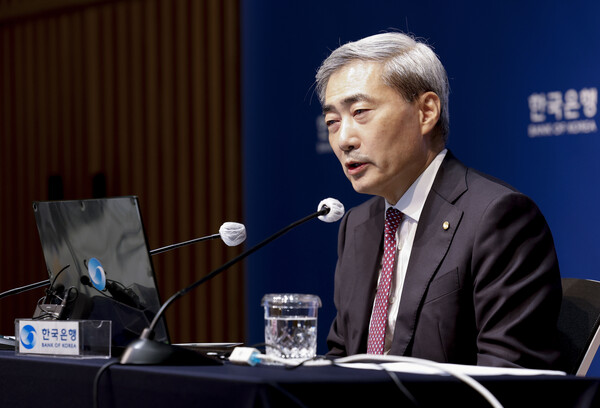
A particularly notable point in the rate decision was the channel through which rising semiconductor prices spill over into income and domestic demand. Governor Hyun Song Shin (신현송) said at a news conference that as global AI spreads, South Korea is benefiting as a key value-chain country. He said a sharp rise in semiconductor prices could lead to a domestic-demand recovery through higher corporate profits and investment, wages and tax revenue.
In the first quarter, gross domestic product rose 3.8 percent from a year earlier, while gross domestic income increased 13.2 percent. Income returning to the domestic economy rose faster than output as the terms of trade improved on rising semiconductor prices as well as export volumes.
Shin said if such income gains spread into consumption, they could increase demand-side inflation pressure, and stressed, "Let's watch semiconductor prices rather than stock prices." He said semiconductor prices could offer significant implications for the long-term growth trend and future monetary policy.
Brokerages also described this month's board meeting as 'the moment it became confident about demand-side inflation.' Jun-woo Park (박준우), a researcher at Hana Securities, said that if the May meeting marked the point when the board left open the possibility of demand-side price pressures, this meeting was an event that showed strong confidence in that view.
Accumulated financial stability risks also served as another backdrop to the rate hike. Household loans at banks rose 7.6 trillion won in June. Mortgage loans increased 4.3 trillion won and other loans gained 3.3 trillion won. The rise in home prices in the Seoul metropolitan area widened to 0.7 percent in June from 0.5 percent in May and 0.3 percent in April, while Seoul gained 1.0 percent in June alone. The won-dollar exchange rate also showed high volatility, at one point rising into the mid-1,500 won range.
◆Rate hike for financial stability likely to increase burden on companies, households
Still, the rate hike carried out for financial stability could create a new burden for companies, households and financial markets.
Rising market interest rates can lift funding costs and interest burdens, while a more volatile stock market could increase the risk of losses for investors using margin trading.
If stock market volatility expands, forced selling could increase for borrowers using margin loans and unsettled share purchases, potentially raising losses for retail investors. Shin said, however, that the possibility that the recent stock price drop could spread into a risk to the broader financial system was limited.
Interest burdens for companies and households are also expected to expand. If market rates rise, corporate bond issuance and bank borrowing costs will increase, which could worsen corporate financing conditions. For low- and mid-credit borrowers, small self-employed business owners and vulnerable firms, debt repayment burdens could rise relatively more, increasing the risks of delinquency and distress.
The Financial Supervisory Service also began checking for side effects from the rate hike. The FSS said it would hold a meeting to review financial conditions right after the policy rate increase and examine trends in margin loans and unsettled share purchases by securities firms and the possibility of forced selling.
It also plans to check corporate financing conditions, interest burdens for vulnerable borrowers, the loan delinquency rate and the possibility of broader distress, and to manage so that financial companies' supply of funds does not shrink excessively.
◆Financial market burden grows, but BOK keeps door open to more hikes
Market attention therefore focused on whether this hike would mark the start of a full-fledged tightening cycle.
The BOK appears to have left open the possibility of additional hikes even after this decision. Shin said every future meeting is a 'live meeting' in which policy can change depending on economic indicators, and he did not rule out the possibility of further rate increases. The BOK said it would decide whether to raise rates further after checking second-quarter GDP and GDI, July core and living-cost inflation, expected inflation and semiconductor price trends.
A key variable that will determine the future rate direction appears to be how long the semiconductor boom lasts and how quickly higher income spreads into consumption and prices. If home prices and household loans in the Seoul metropolitan area continue to expand while growth remains strong, the possibility of further tightening could increase.
Conversely, if higher interest rates curb corporate financing, vulnerable borrowers, employment and consumption faster than expected, the pace of further hikes could slow. Ultimately, the future monetary policy path is expected to depend on which effect becomes stronger: the semiconductor boom lifting exports and income, or raising inflation pressure.
Park said, "If the BOK maintains its current assessment of the growth trend, the possibility of an August hike also seems fully open," adding, "Emphasising 'real-economy indicators' rather than financial markets such as the stock market means the tightening stance will not change easily." Hana Securities forecast additional hikes in August and November and in February next year, bringing the terminal rate to 3.50 percent a year.
He said, "In light of corporate profit outlooks, the possibility that semiconductor prices, strong exports and growth indicators will turn down in the short term is limited," adding, "As we are in the early phase of hikes, this is a time to focus on a strong tightening stance."
 Ji-young Lee
ljy@d-today.co.kr
Ji-young Lee
ljy@d-today.co.kr