
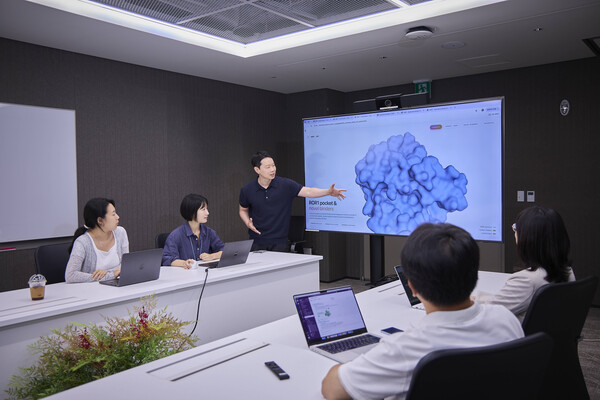
SK Telecom and SK Biopharm have discovered early-stage effective compounds that could be used to develop targeted therapies for hard-to-treat cancers using AI.
SK Telecom said on Tuesday it jointly researched with SK Biopharm to generate and select binder candidates that can bind to ROR1, a protein on the surface of cancer cells, and confirmed 2 early-stage effective compounds through laboratory validation.
An effective compound is a substance shown in tests to bind effectively to a target. A binder is a substance designed to attach to a specific target such as cancer cells. ROR1 is a tumour-related cell surface protein produced in large amounts in various blood cancers and solid tumours. It is drawing attention in the development of targeted anticancer therapies because it appears more in some cancer types than in normal cells.
In the study, SK Biopharm established a strategy to discover new binders based on its drug development experience. SKT used AI to generate a large number of binder candidates and analysed the likelihood of binding with ROR1 to select targets for laboratory validation.
Research to find new molecular structures often has limits in exploring diverse candidates because there is frequently not enough data for AI to learn from. SKT applied machine learning technology that combines and expresses protein fragments in various ways to address this.
It also used reinforcement learning. It made AI give higher rewards to combinations with greater structural stability so it could search for optimal new binder structures.
At the selection stage, it used graphics processing unit, or GPU, resources to process multiple binder candidates in parallel. It then used an AI model to predict the binding structure between ROR1 and each candidate and the likelihood of actual binding, narrowing down targets for laboratory validation.
The two companies completed the study in about 5 months. They cut by more than 60 percent the early-stage research period for drug development that typically took 1 to 2 years under SK Biopharm's existing approach. SKT assessed the study as showing the possibility of reducing the time and cost needed in the early stage of drug development using AI.
Dong-yeon Jo (조동연), head of AI Convergence at SKT, said, "Based on this achievement, we are also reviewing ways to expand the scope of technology cooperation across bio AI, including developing a bio-specialised large language model (LLM) using our proprietary AI foundation model."
 Jin-ho Lee
jhlee26@d-today.co.kr
Jin-ho Lee
jhlee26@d-today.co.kr