
The government will open an era of "AI for Everyone" by providing a free, general-purpose AI chatbot using domestic AI models to all citizens within this year. Next year it will advance it into AI agents, opening an era of "one AI agent per person" for all citizens.
It will strengthen support so that a hyperscale AI data centre built with a total of 550 trillion won in private investment can operate without disruption. It will begin developing an independent world model to secure physical AI competitiveness at the world’s top level. It will also focus on becoming one of the world’s five leading space powers, including completing the fifth launch of the Nuri rocket in the second half of this year and launching a lunar-orbit communications satellite in 2029.
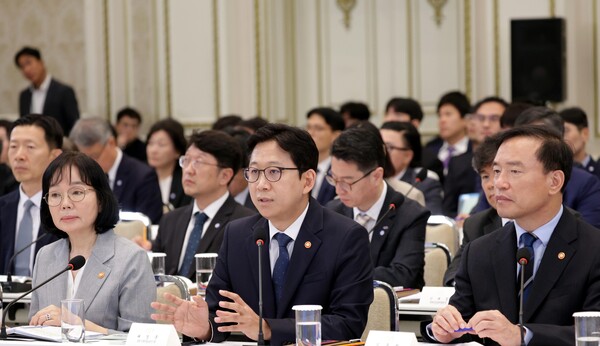
The Ministry of Science and ICT and the Korea AeroSpace Administration on Wednesday announced these plans for the second half of 2026 at a presidential work briefing at the State Guesthouse at Cheong Wa Dae.
The ministry set its goal as building an "irreplaceable Republic of Korea where people are happy together through AI and science and technology" and presented core tasks including realising a basic AI society and pushing three mega-projects: AI data centres, physical AI and K-AI semiconductors.
DOMESTIC AI CHATBOT TO BE FREE, AI DATA CENTRES TO EXPAND
The ministry will launch the "AI for Everyone" service in December, based on domestic AI models. It will provide a general-purpose AI chatbot like ChatGPT without cost burdens or usage limits. It will also include functions to find and guide government benefits available to citizens, such as scholarships and youth support payments, and support applications. From next year, it will upgrade it into AI agents that carry out tasks such as reservations and payments.
Jin-ho Gong (공진호), director of the AI Policy Planning Division at the ministry, said at a pre-briefing on Tuesday that the basic principle is to make it easy for all citizens to use AI without 부담. He said the ministry is also considering how the value of AI for Everyone circulates as it is upgraded into AI agents.
The ministry also plans to provide AI education opportunities to 5,140,000 people within this year and to roll out 생활 밀착형 AI services in stages, including agricultural and livestock product price comparisons, AI tax consultations, national heritage interpretation, and crisis response for children and adolescents. It aims to launch a total of 10 services by next year, including these.
It will foster AI data centres as a national strategic industry. It will use a three-pillar support system, including an inter-ministerial task force, a public-private alliance, and a dedicated support team, to quickly push administrative procedures companies need, such as securing power and sites and obtaining permits, so that gigawatt-class AI data centres pursued by SK, GS and Naver with total investment of 550 trillion won can be built without disruption.
Next year it will promote localisation and advancement of core solutions and key equipment for AI data centres, including IT, power and cooling. It also plans to provide packaged support in talent, test labs, finance and exports, linked to cluster development.
The ministry plans to secure an independent AI model in the global top 10 in the second half of this year and to concentrate support for GPUs, data and talent to advance it into a model in the global top tier. It will secure about 50,000 advanced GPUs by 2028, based on Nvidia B200, and will open its sixth supercomputer in September. Deputy Prime Minister Bae said that if infrastructure support is strengthened further, South Korea can develop a mythos-class frontier AI model.
In physical AI, it is aiming for the world’s top position. It will start developing an independent world model this year and, based on accumulated data, develop a physical AI foundation model at the world’s top level within three years. It will apply it to manufacturing, defence, care and agriculture and foster it as an export industry.
For AI semiconductors, it will build a full-package ecosystem made up of domestic technologies spanning chips, infrastructure, networks, software and services. It will also start developing 1-nanometre-class semiconductors and next-generation high-bandwidth memory (HBM). It will establish a detailed roadmap for related projects within this year. Eok Yoon (윤억), director of the R&D Policy Division, said the goal of next-generation semiconductor technology development is to improve performance by more than 10 times compared with existing technology. He said it is a project to develop dual stacking combined with computing elements and to improve energy efficiency.
SECURITY-FOCUSED AI MODEL TO BE DEVELOPED, REGIONAL AX HUBS TO EXPAND
It will also strengthen responses to security threats stemming from AI adoption. Since July, the ministry has been using advanced AI to check vulnerabilities in infrastructure in areas tied to citizens’ lives and safety, including telecommunications and platforms. In the second half, it will develop and distribute a security-focused AI model based on a domestic independent AI model. It will also push safety assessments of major AI models and disclosure of results, as well as building datasets for evaluations.
To ease the burden of telecom costs, it will draw up measures to strengthen the competitiveness of low-cost mobile carriers in July and begin notifying users of optimal rate plans from October. It will strengthen indoor 5G quality assessments and upgrade public Wi-Fi on subways and city and metropolitan buses.
It will expand support for AI talent and startups. Public-private joint investment funds supplied to AI startups will be expanded to 2 trillion won within this year. It will also create a 20 billion won "AI Venture Fund" for early-stage AI startups.
It will establish two gifted schools affiliated with science and technology institutes in North Chungcheong Province and Gwangju, and convert around three existing high schools into gifted schools. By supporting research funds, visas and housing, it will attract about 600 overseas talents to South Korea within this year. It will operate AI-focused universities and AX graduate schools, and expand startup institutes within science and technology institutes from 1 to 4 to identify more than 500 deep tech startup teams within this year.
In the regions, it will build four AX hubs in the second half, centred on mobility and energy in the southwest, precision manufacturing in the southeast, bio-healthcare and robots in Daegu and North Gyeongsang Province, and AI factories in North Jeolla Province. Next year it plans to expand to a nationwide AX system by adding the central region, Gangwon Province and Jeju.
K-MOONSHOT TO BE PUSHED IN EARNEST, 50-QUBIT DOMESTIC QUANTUM COMPUTER THIS YEAR
It will push in earnest "K-Moonshot" to apply AI to science and technology research. The mission-oriented R&D programme aims to solve 12 national challenges needed for a major leap in national competitiveness by 2035 using AI. First Vice Minister Hyuk-chae Koo (구혁채) said work to organise milestones by field will be completed soon. He said the ministry will explain the overall plan in August.
In quantum, it will secure a 50-qubit domestic quantum computer within this year and develop a 100-qubit error-correction quantum computer by 2029. It will also designate quantum clusters to find region-based quantum use cases.
In new drugs, it will build autonomous experimentation infrastructure in which candidate materials designed by AI are verified by AI and robots. It will start developing a cancer-focused AI model next year and plans to 공개 an initial model at the end of 2028. In the brain-computer interface (BCI) field, it will launch an industry-academia-research-hospital consultative body in August. From next year it will develop AI core technologies to interpret signals between the brain and computers and push product demonstrations for quadriplegia patients in 2030.
It will also apply AI to research administration. It will use AI for selecting evaluation committee members, monitoring research funds and interpreting research administration rules to increase fairness and trust in R&D management.
It will expand links between research institution systems and the pan-government Integrated Research Support System (IRIS) to resolve burdens on researchers who must enter information redundantly in both systems. Major research support systems that had been operated separately, including research projects (IRIS), research funds (Ezbaro and RCMS), and performance disclosure (NTIS), will be integrated by 2028. It will also introduce a system to support follow-up research when the process is excellent even if research goals are not met, described as "assetising failure".
For emerging technology fields where private investment is difficult, it will introduce "investment-type R&D" in which the government shares risk and, when investment succeeds, enables a virtuous cycle of recovery and reinvestment. It will establish legal grounds by enacting a public notice within this year and begin a pilot project next year.
With the gradual abolition of the project-based system (PBS), it will establish unique missions for each government-funded research institute within this year. It will integrate common administrative functions across institutes, including audits, hiring and public relations, and improve technology transfer rules so that royalty income at government-funded institutes can be used as bonuses for outstanding employees.
NURI 5TH LAUNCH, REUSABLE LAUNCH VEHICLES AND LUNAR ECONOMY PUSH
The Korea AeroSpace Administration will push the fifth launch of the Nuri rocket in the second half of this year, carrying 15 satellites including ultra-small clustered satellites, with the goal of becoming one of the world’s five leading space powers. It will also proceed with developing a reusable next-generation launch vehicle to cut launch costs to one-tenth of current levels and selecting a site for a second space centre.
In the second half, it will launch the Lunar Space Environment Monitor (LUSEM) and push launches of a lunar-orbit communications satellite in 2029 and a small lunar lander in 2030. It aims to build a Korean low-Earth-orbit satellite communications network by 2035 and to reach 1,200 space and aerospace companies and a 3 percent global market share.
Deputy Prime Minister Bae, who also serves as minister of science and ICT, said he will create an irreplaceable Republic of Korea where all citizens grow together and are happy through AI and science and technology.
 Jin-ho Lee
jhlee26@d-today.co.kr
Jin-ho Lee
jhlee26@d-today.co.kr