
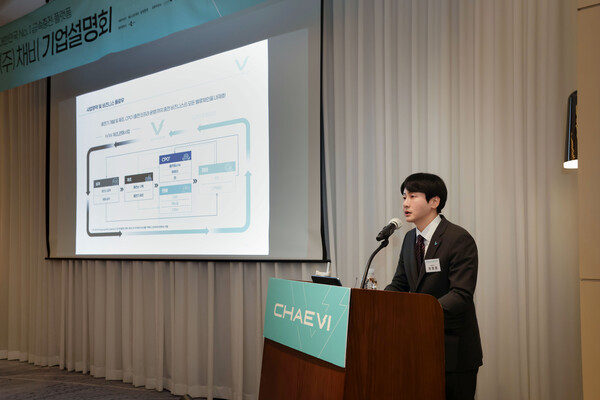
South Korean electric-vehicle fast-charging infrastructure operator (CPO) Chaevi set a target to turn EBITDA profitable in the fourth quarter of this year and to achieve an operating profit next year. Chaevi CEO Choi Young-hoon (최영훈) held a news conference in Seoul’s Yeouido on Monday and outlined the company’s core strengths and growth strategy ahead of a planned Kosdaq listing.
Choi said the company would begin turning EBITDA profitable in the fourth quarter of this year and would enter a full profit phase on an operating profit basis next year. He said the timing could be brought forward as a shortfall in new infrastructure supply is being confirmed against a sharp rise in charging demand. He said Chaevi’s fast chargers are structured to turn profitable at an average of 2.8 charging sessions per bay per day, and that the company already exceeded its early-year target of 2 in the first quarter.
Growth in the EV market is boosting expectations for a return to profit. Cumulative EV sales through March reached 1,020,948 vehicles, topping 1 million for the first time. Total sales this year are expected to reach 400,000 vehicles. Chaevi expects to reach early this year not only its IPO business plan estimate of 240,000 vehicles in circulation, but also its optimistic 2027 figure of 360,000.
Over the same period, the number of new fast chargers installed fell 95 percent from a year earlier, making the supply shortage a reality. The company said the result reflects normalising utilisation rates and supply-demand imbalances at the same time as a shift in demand to fast charging accelerates following the end of a grace period for mandatory installation of slow chargers.
Chaevi said it has secured about 71 percent of its sites on public land with no rent burden, allowing it to achieve a contribution margin of more than 50 percent, compared with 10 to 30 percent for other major CPOs. It directly owns and operates about 6,000 fast-charging bays, the most among private operators in South Korea. Including government supply and operating volumes, it manages more than about 10,000 fast chargers, making it the second-largest operator by global standards. It has also won a maintenance contract for fast-charging facilities from the Ministry of Climate, Energy and Environment for four consecutive years.
Its global business is also accelerating. Chaevi opened a corporate office and logistics warehouse in Riverside, California, and signed supply agreements with UAE energy company EEE, Canada’s Four Season Technology and the U.S. SPT Group. As disbursement of subsidies under the $5.0 billion U.S. National Electric Vehicle Infrastructure (NEVI) program gathers pace, it was selected as an operator and manufacturer for California’s subsidy program, CALeVIP, securing a local reference. It plans to pursue a new manufacturing line in California in the first half of this year and is also reviewing the establishment of a joint venture in India.
Chaevi is seeking a Kosdaq listing as the first EV charging infrastructure operator to do so. It will offer a total of 10 million shares, with a proposed price band of 12,300 won to 15,300 won per share and an offering size of about 123.0 billion won to 153.0 billion won. Bookbuilding will run from April 10 to 16, and subscriptions will be held on April 20 to 21. The lead managers are KB Securities and Samsung Securities, with Daishin Securities and Hana Securities as co-managers.
Choi said the fast-charging infrastructure market is a winner-takes-all market, where an operator that secures key sites first and has an overwhelming market share takes all accumulated demand. He said the company would capture charging demand in an era of 1 million EVs to cement its winner status, and would further strengthen its competitiveness as the top fast-charging CPO.
 Seok Dae-geon
d2dg@d-today.co.kr
Seok Dae-geon
d2dg@d-today.co.kr