
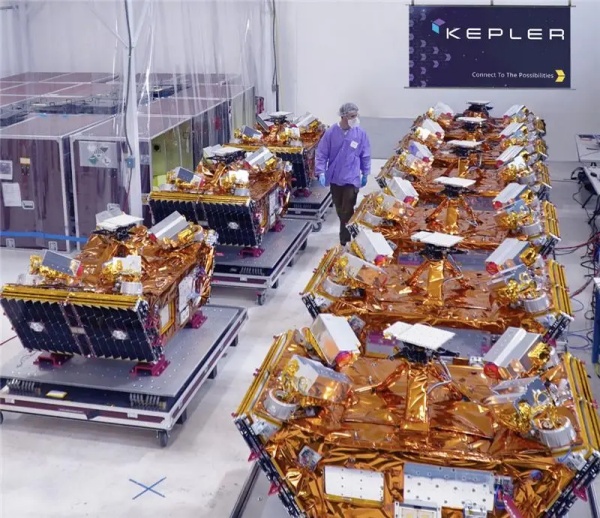
Canadian space communications company Kepler Communications is moving to expand the space data processing market, led by the largest compute cluster currently operating in orbit.
According to IT outlet TechCrunch on April 13 local time, Kepler equipped 10 satellites launched in January with about 40 Nvidia Orin edge processors. It is operating them by linking the satellites through laser communication links. They operate like a single compute cluster in orbit, and the company views it as one of the largest computing infrastructures currently operating in orbit.
Kepler currently has 18 customers and recently added space software startup Sofia Space as a new customer. Sofia Space plans to load its operating system onto Kepler's satellite network and run software in a test in an actual space environment.
The core of the cooperation is to prove the effectiveness of a model that processes data immediately in orbit before building a large space data centre. The industry sees large space data centres envisioned by SpaceX or Blue Origin as likely to take shape after the 2030s. Before that stage, analysis suggests demand is likely to form first for processing satellite sensor data on site to increase response speed.
Technically, the focus is on inference-centred computation based on distributed GPUs. Kepler views fast data processing using GPUs distributed across multiple satellites as more suitable for the space environment than ultra-large training computation. It also stressed that its current GPU utilisation is close to 100%.
Sofia Space is separately developing a space computer that uses passive cooling. This is an approach aimed at solving heat issues seen as a key challenge for large orbital data centres. It aims for a structure that maintains high-performance computation without heavy and costly active cooling devices.
In this experiment, the two companies plan to upload Sofia Space's proprietary operating system to 1 Kepler satellite and run it on 6 GPUs across 2 spacecraft. It is a routine task on the ground, but it is significant because it is the first time this type of software deployment and configuration has been attempted in orbit.
The cooperation is also significant for Kepler. Kepler is currently processing data uploaded from the ground or data collected by payloads mounted on its satellites. It plans to expand its business by linking with external satellites to provide networking and computing services.
The U.S. military is also cited as a major customer group for such demand. The United States is developing a new missile defence system in which satellites detect and track threats, and rapid on-site data processing becomes important in such a structure. Kepler has already conducted a space-to-air laser link demonstration for the U.S. government.
Market conditions are also a variable. As some parts of the United States show moves to restrict data centre construction or tighten regulation, the possibility is being raised that space-based data processing infrastructure could emerge as an alternative in the long term. Sofia Space sees those changes as potentially stimulating market demand faster than expected.
The industry sees the Kepler-Sofia Space cooperation as a test bed for gauging the direction of future competition in space data centres. Before competition over large-scale facilities, how quickly and efficiently data can be processed in orbit is expected to be a key variable in securing an early market lead.
 Jinju Hong
hongjj@d-today.co.kr
Jinju Hong
hongjj@d-today.co.kr