
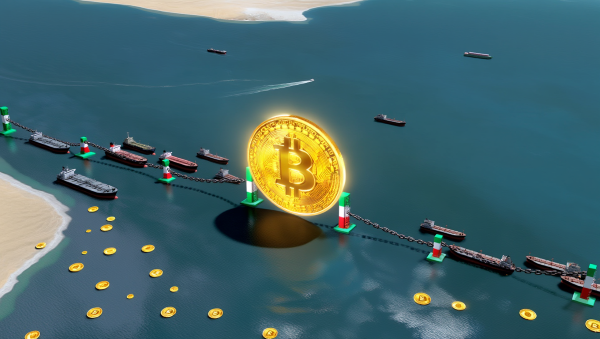
Shipping companies could face significant sanctions risks if they pay Iran in cryptocurrency under the pretext of tolls or other fees, a warning has been raised.
Cointelegraph reported on April 11 that Caitlin Martin, senior intelligence analyst at crypto analytics firm Chainalysis, said under the current sanctions framework, payments made to the Iranian regime could be regarded as "material support" even if the costs are related to passage through key waterways.
Martin said such payments could lead to violations of restrictions imposed by the United States and the international community. She said the Islamic Revolutionary Guard Corps is sanctioned across multiple jurisdictions, and Iran is also subject to comprehensive U.S. sanctions, meaning such payments could carry a "significant risk of sanctions violations".
The warning comes amid reports that Iran could seek to collect vessel tolls in cryptocurrency. U.S. President Donald Trump has said he would not accept Tehran's attempt to impose tolls on ships passing through key waterways.
Chainalysis pointed to Iran's growing use of digital assets as the background to the warning. Citing public data, Martin said Iran has supported trade in oil, weapons and raw materials, particularly by using stablecoins. She added that cryptocurrency is not a complete solution for evading sanctions.
She said blockchain transactions enable cross-border transfers outside traditional financial networks, but records are inherently transparent and remain permanently. "In many respects, cryptocurrency is easier to trace than traditional sanctions evasion methods," she said, adding that law enforcement can follow money flows to cash-out points and freeze or seize assets.
The approach is not limited to Iran. Russia has also been cited as using digital tokens such as A7A5 to support cross-border transactions after being sanctioned following its 2022 invasion of Ukraine. Sanctioned countries are seeking payment methods outside the traditional financial system, but the public nature of blockchain networks can itself become a trail for tracking, it added.
Iran's bitcoin mining indicators have also recently been wavering. Iran's bitcoin mining power fell by about 7 exahashes per second in the latest quarter to around 2 exahashes per second, the report said. The global bitcoin network remained relatively stable with the total hash rate holding around 1,000 exahashes per second, and the impact did not spread to neighbouring countries such as the United Arab Emirates and Oman.
Market participants are expected to focus on whether Iran will actually use cryptocurrency to collect maritime transport-related costs, and how far sanctions authorities in each country will track related wallets and cash-out routes. Chainalysis' warning shows that, separate from concerns that cryptocurrency could be used to evade sanctions, shipping companies' legal and operational burdens could grow because transaction structures leave traces.
IRAN DEMANDS TOLLS IN BITCOIN Iran plans to require oil tankers to pay a $1/barrel toll in BTC to transit the Strait of Hormuz - with strict verification, and VERY severe enforcement. Our research team broke down Iran’s new Bitcoin Toll and what it means for global shipping: pic.twitter.com/A5jp3KSlTd
 Yoonseo Lee
yslee@d-today.co.kr
Yoonseo Lee
yslee@d-today.co.kr