
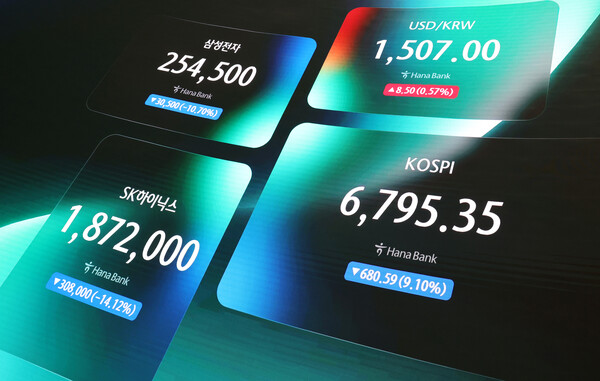
South Korean stocks faced a "Black Monday" as a dump of semiconductor shares and combined selling by foreign and institutional investors hit the market. The KOSPI slumped nearly 9 percent to the 6,800 level, and the KOSDAQ fell below 800.
On July 13, the KOSPI ended down 669.01 points, or 8.95 percent, at 6,806.93. The index opened 63.91 points, or 0.85 percent, lower at 7,412.03 and then quickly widened its losses.
In the main board market, foreigners sold a net 1.7064 trillion won and institutions sold a net 2.1965 trillion won. Retail investors bought a net 3.8810 trillion won, absorbing the selling.
The Korea Exchange triggered a sell-sidecar in the main board market at 10:34 a.m. As the decline continued, it triggered a first-stage circuit breaker at 1:28 p.m. after the KOSPI fell 8.08 percent from the previous session to 6,871.20.
The main board circuit breaker was triggered for the seventh time this year and the 13th time on record. Trading in main board-listed stocks and related derivatives, excluding bonds, was halted for 20 minutes.
Among the top market-cap stocks, semiconductor-related shares posted notable declines.
Samsung Electronics closed down 30,500 won, or 10.70 percent, at 254,500 won. SK Hynix fell 335,000 won, or 15.37 percent, to 1,845,000 won.
Elsewhere, SK Square fell 17.60 percent and Samsung Electro-Mechanics dropped 18.62 percent. Hyundai Motor slid 2.95 percent and Samsung Life fell 4.26 percent.
LG Energy Solution rose 0.77 percent, KB Financial Group gained 0.98 percent and Samsung Biologics added 0.36 percent.
The KOSDAQ ended down 38.07 points, or 4.55 percent, at 799.36. It rose more than 2 percent early in the session, but turned lower amid the KOSPI plunge and spreading risk-averse sentiment. Losses widened late in the session, pushing it below 800.
The won was at 1,502.60 per dollar, down 0.60 won, or 0.04 percent, from the previous session. The currency, which had been falling early in the session, turned higher as foreign selling expanded.
Han Ji-young (한지영), a researcher at Kiwoom Securities, said concerns about a peak-out in the memory cycle had not been eased despite strong demand for SK Hynix's U.S. American depositary receipts listing. He said a string of steep declines in semiconductor shares was increasing investor fatigue and leading to an exit of flows.
He added that a renewed escalation in U.S.-Iran tensions, which lifted oil prices and U.S. Treasury yields, also weighed on the market.
 Sang-yeop Oh
yub@d-today.co.kr
Sang-yeop Oh
yub@d-today.co.kr