
[Digital Today reporter Ho-jung Lee] With the government conditionally approving Google’s export of high-precision map data from South Korea, Naver and Kakao have moved to upgrade their map services. The move is seen as an effort to strengthen the advantages of existing map services in preparation for Google Maps expanding its influence in South Korea as its navigation competitiveness is likely to improve.
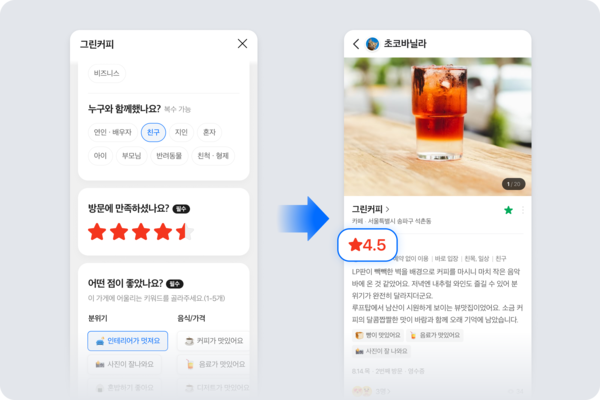
According to the industry on April 13, Naver reintroduced star rating reviews to Naver Place on April 6. It was the first time since Naver scrapped the feature in October 2021 due to malicious reviews. Business owners can choose whether the rating is displayed. In the initial stage, it is disclosed only to the reviewer and the business owner. Naver also introduced an anti-abuse measure that allows edits only within 3 months after a review is written.
KakaoMap is strengthening reviews verified through payment and on-site photo authentication. It is also operating a “most helpful” sorting option that places verified reviews at the top. It also added a function that allows users to report malicious reviews even when a review is set to private. KakaoTalk’s “Friend Location” service, which lets friends share real-time locations, added a feature that automatically sends an alert when a friend is nearby. The update came 5 months after the service was revamped in November last year to allow unlimited location sharing. A service that has built an ultra-precise bus data production and verification system with the Seoul Metropolitan Government’s Future Advanced Transportation Division of the Transportation Office for about 2 years is discussing formal adoption in the second half of this year.
Star ratings vs verification...different methods, same goal
The two companies’ strategies differ in direction. Naver chose “quantification.” It added star ratings as a supplementary indicator to text and keyword-based qualitative reviews, so users can see at a glance “how good it is” by turning satisfaction into a number.
Kakao chose “verification.” It aims to reduce the possibility of false reviews by using payment and on-site photo authentication, and to accumulate data linked to actual consumer behaviour by placing verified data at the top. Efforts to link seasonal and location data to everyday services, such as a “Cherry Blossom Map” that provides real-time blooming status for about 100 cherry blossom spots on a map, are also an extension of that direction.
The methods differ but the aim is the same. It is to secure “experience data” that records where users go, which routes they take and which places they choose. Map platforms are a representative service that can directly confirm a user’s location, movement routes and place preferences. If search collects “intent data” and commerce gathers “purchase data,” maps capture broad offline behaviour data that fills the gap between them.
This experience data can be used in the short term to refine advertising and improve service recommendations. Over the medium to long term, it could be used as key input data for autonomous driving, digital twin and AI agent services. As data accumulates on floating population, congestion by time slot and movement patterns, the scope of use goes beyond navigation.
Local data assets are an area Google is unlikely to replace quickly
Securing high-precision maps does not automatically bring competitiveness. The commercial district databases, user review ecosystems, and payment and mobility linkages that Naver and Kakao have built over years are assets that are difficult to build in a short period of time. The user bases of local operators also remain solid. According to Mobile Index, Naver Map’s monthly active users reached a record high of 29.52 million last month, while KakaoMap had 12.82 million and Google Maps was tallied at 9.68 million.
Reviews registered directly by small business owners and accumulated by users, and networks that connect daily services such as delivery, taxis and restaurant reservations cannot be replicated with capital alone. That is why the latest revamps by the two companies focus on raising the quality and reliability of existing data assets rather than adding new functions.
The Google factor is becoming a catalyst that shifts the axis of competition in South Korea’s map services from “navigation” to “experience data.”
An industry official said, “Even if Google secures high-precision maps, the review ecosystem and daily service linkage networks that local operators have built over years will not be shaken overnight.” The official added, “In the end, the real yardstick that decides competition will be how much experience users leave within a platform.”
 Ho-jung Lee
lhj@d-today.co.kr
Ho-jung Lee
lhj@d-today.co.kr