
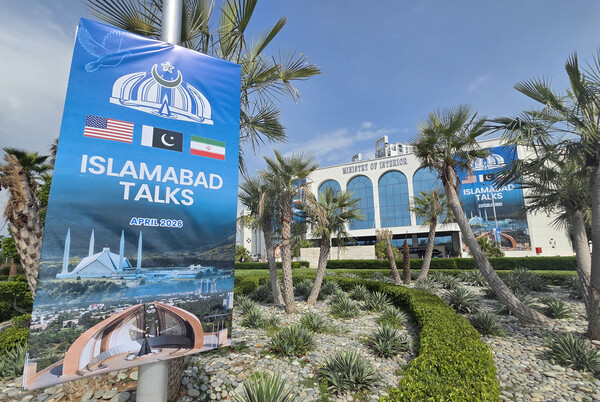
A military clash in the Middle East is reaching a turning point with a temporary ceasefire agreement, leaving South Korean stocks caught between hopes for an end to the war and uncertainty. Brokerages advised investors to watch beneficiaries of a weaker dollar and sectors expected to post improving earnings this week.
The KOSPI ended trading on April 10 up 1.40 percent from the previous session at 5,858.87. Talks between the United States and Iran have resumed, keeping the direction toward ending the war intact, but volatility in the negotiation process looks unavoidable, including whether supply chains in the Strait of Hormuz normalise and whether transit fees are imposed.
Expectations for a U.S. Federal Reserve rate cut and the possibility of a shift toward a weaker dollar are likely to be supportive factors for South Korean stocks.
Concerns about a slowdown in U.S. economic growth are raising the likelihood of a drop in short-term market interest rates, and worries that a prolonged war could widen the U.S. fiscal deficit may spur dollar weakness, the analysis said.
Jae-man Lee (이재만), an analyst at Hana Securities, said foreign funds are likely to flow into Samsung Electronics or SK Hynix during a weak-dollar phase. He said Samsung Electronics' foreign ownership stake is 48.6 percent, the lowest level since 2020.
That calls for a concentrated strategy targeting sectors and stocks with a high likelihood of attracting foreign inflows. In the South Korean market, sectors where foreign net buying has been strong during periods of dollar weakness include machinery, information technology (IT) hardware, shipbuilding, defence, and chemicals.
Considering earnings drivers for each sector, Doosan Enerbility, HD Hyundai Electric, Samsung Heavy Industries, Hyundai Rotem and Daeduck Electronics were cited as promising stocks.
Scheduled releases of key macro indicators and monetary policy events could add to market volatility.
The U.S. producer price index (PPI) for March will be released on April 14, and a confirmation hearing is set for April 16 for Kevin Warsh, the nominee for the next Fed chair. If the U.S. consumer price index (CPI) for March is also released above expectations, it could stoke inflation concerns due to the impact of a surge in energy prices.
Hae-chang Jeong (정해창), an analyst at Daishin Securities, said he recommends a tactical response that focuses strategically on the direction toward ending the war while using noise in negotiations and short-term swings in sentiment. He said an active increase in exposure that takes advantage of gains and declines remains valid even if future conditions reflect concerns about growth and inflation.
Dong-gil Noh (노동길), an analyst at Shinhan Investment Corp, added that it is questionable whether a two-week ceasefire period is enough to end the war. He said investors need to select sectors with high earnings visibility and without a heavy valuation burden, such as semiconductors, high-dividend stocks and domestic consumer names.
 Oh Sang-yup
yub@d-today.co.kr
Oh Sang-yup
yub@d-today.co.kr