
Small business owners with limited financial histories will be able to obtain bank loans through AI-based credit assessments based on non-financial information such as sales, industry and business district. The existing evaluation method, centered on collateral or past financial history, is expected to shift to one focused on data and future growth potential.
The Financial Services Commission held the third meeting of its Credit Evaluation System Reform Task Force on April 9 at the Korea Federation of Banks building and announced a plan to introduce a small business-focused credit assessment system (SCB, Small business & self-ownership Credit Bureau).
As of 2025, small businesses total about 7.9 million, accounting for 95 percent of all businesses, and employ 10.9 million people, or 46 percent of the total employed population, forming a key base of the domestic economy. But about 90 percent of individual business loans remain concentrated in collateral and guaranteed loans (collateral 79.8 percent, guarantees and others 10.6 percent). Funding for small business owners with limited credit histories is effectively blocked.
At a small business field meeting last year, one participant said: "I got a 20 million won unsecured loan after getting a job at 28 and working for 3 months, but my mother, who ran a business for 30 years, could not get a loan even though she repaid faithfully and used a private loan."
AI to assess growth potential by industry in 10 tiers
The SCB to be introduced is an AI-based model that assesses small business owners' future growth potential based on non-financial information, including detailed sales analysis, business district analysis, business continuity, years in business, number of workers and a distribution platform growth index. Industries are divided into wholesale and retail, accommodation and food service, other services and technology sectors, with comparative assessments among similar industries.
Results are calculated on a 10-tier scale: excellent (S1 and S2), good (S3 and S4), average (S5 and S6), insufficient (S7 to S9) and vulnerable (S10). The higher the growth grade (S grade), the more the existing credit grade (CB) is adjusted upward, and borrowers can receive benefits such as loan approvals, higher limits and preferential interest rates.
Grades are calculated by combining quantitative and non-quantitative models. Data such as sales, business districts and years in business are first analysed by AI to produce a quantitative growth grade. Then the final grade is confirmed by awarding additional points in a non-quantitative model that reflects qualitative factors such as the owner's capabilities, service differentiation, intellectual property and online platform information.
Seven banks to pilot in second half with 1.8 trillion won in screening
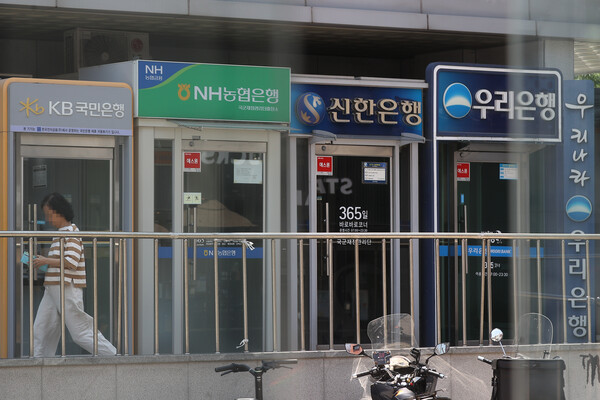
Targeting August, the SCB will first be piloted in screening about 1.8 trillion won in small business loans at 7 banks, including KB Kookmin, Shinhan, Hana, Woori, NongHyup, IBK and Jeju Bank. The FSC plans to assess pilot results in the second half of 2027, then pursue customised upgrades of the SCB for each credit bureau and financial firm, and expand it across the financial sector from 2028.
At the same time, a Small Business Integrated Information Center (SDB) will be built within the Korea Credit Information Services to systematically collect and manage small business non-financial information. The SDB is expected to support development of small business-focused products, tailored financial consulting and a service explaining growth-grade assessments.
In addition, an SCB usage guideline will be prepared and distributed. It will introduce an exemption system when financial company employees use the SCB in loan screening and reflect such use in performance evaluations. Banks' SCB usage results will also be reflected in social contribution results and an inclusive finance comprehensive evaluation.
The FSC estimated that once the SCB takes root, about 700,000 people will receive new loans worth about 10.5 trillion won annually, with an interest-rate reduction effect of about 84.5 billion won.
About 320,000 small business owners with mid-to-low credit are expected to be upgraded to the top S grade, with annual new and additional loans of 5.4 trillion won and an expected interest-rate reduction of 69.7 billion won. About 380,000 existing high-credit small business owners are also expected to receive additional loan benefits of 5.1 trillion won through limit and rate preferences.
FSC Chairman Eok-won Lee (이억원) said introducing the SCB is a starting point for moving away from finance that relies on collateral or past financial histories and toward future-oriented finance that supplies funds centered on data and future growth potential. He stressed that a structural shift is important so that funds are supplied through appropriate evaluation to small business owners with high growth potential even if their financial conditions are somewhat insufficient.
Korea Federation of Micro Enterprise Association welcomes move, says it will address financial blind spots
The Korea Federation of Micro Enterprise Association also expressed strong support. The group said the SCB "is the result of the government reflecting the voices from the field and will serve as a catalyst for addressing practical financial blind spots." It said it expects the new system to substantially resolve problems of information asymmetry in financial information and credit discrepancies.
SoGongYeon Chairman Chi-young Song (송치영) said, "Pilot operations and supplementation will be needed until the system takes root, but the Korea Federation of Micro Enterprise Association will support it as much as possible so the SCB works in practice in the field."
Banks participating in the pilot are also showing willingness to take part actively. In the case of Hana Bank, it plans to use the SCB to identify small business owners with strong business capabilities and growth potential and provide practical financial benefits that can support their sustainable growth.
A Hana Bank official said the bank will actively use SCB grades in screening for its personal business and small business-focused product, the "Hana The SOHO Credit Loan." The official said Hana Bank also plans to newly launch a tailored credit loan product for small business owners with preferential benefits by SCB grade and to develop its own SCB model using data accumulated through the pilot to push continuous upgrades.
 Ji-young Lee
ljy@d-today.co.kr
Ji-young Lee
ljy@d-today.co.kr