
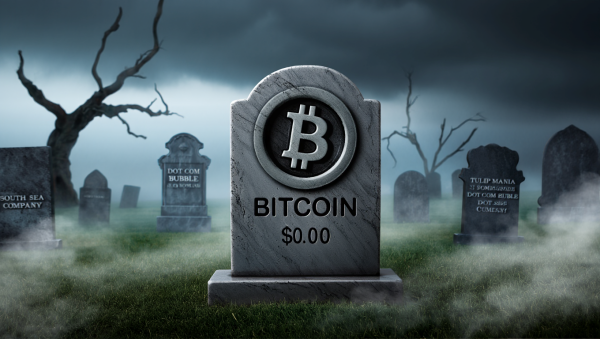
[Digital Today reporter Jinju Hong] Economist Steve Keen, who foresaw the 2008 financial crisis, warned that the value of bitcoin (BTC) could eventually fall to 0 (Zero), heightening tension in the market.
On April 7 local time, blockchain media outlet The Crypto Basic reported that Keen recently appeared on the podcast "The Diary Of A CEO" and argued that bitcoin has structural vulnerabilities in its long-term sustainability.
The top problem he cited was bitcoin's "dependence on energy". Because network security relies on energy-intensive computation, it carries a heavy cost burden. In an environment where countries face pressure to cut energy consumption, it could become a target of policy and regulation. Keen said high-energy systems like bitcoin could be put in the regulatory spotlight as climate and resource issues grow.
He said geopolitical instability also amplifies such weaknesses. Citing examples such as tensions involving Iran, Keen said global crises could disrupt energy supplies. If supplies become unstable, governments would have no choice but to prioritise essential services such as heating and food production. He also laid out a scenario in which energy-hungry networks could be pushed down the priority list or shut down in that process.
He was also sceptical about its function as money. Keen said bitcoin remains in a grey area between a speculative asset and a practical currency. Referring to Gresham's Law, he said assets expected to rise in value tend to be held rather than spent. He argued that this behaviour limits its use as a medium of exchange and weakens bitcoin's original purpose.
He also pointed to the fixed issuance design as a risk factor. Keen said a fixed-supply model could create persistent deflationary pressure and dampen consumption and investment. He argued deflation can raise the real burden of debt and slow economic activity, making it more harmful in the long term.
Keen's view did not stop at bitcoin. He compared the current market, where more than 20,000 tokens are proliferating, to the so-called "Cambrian explosion" when biodiversity on Earth surged about 542 million years ago, and said a sharp contraction could eventually come. He said many projects would struggle to survive because they lack trust and institutional backing, and only a small number of assets could remain.
He also directly challenged the view of bitcoin as "digital gold". Keen said bitcoin prices tend to move with risky assets such as tech stocks, which conflicts with the claim that it is a stable store of value. He also said its value is driven more by expectations than by intrinsic utility, adding that it is closer to the "Greater Fool Theory", in which prices are supported by the expectation that someone will buy at a higher price.
 Jinju Hong
hongjj@d-today.co.kr
Jinju Hong
hongjj@d-today.co.kr