
With the advent of the artificial intelligence (AI) era, calls have been raised in South Korea's National Assembly to foster the platform industry as a strategic sector rather than a target of regulation. A draft "Platform Industry Promotion Act" was also unveiled for that purpose.
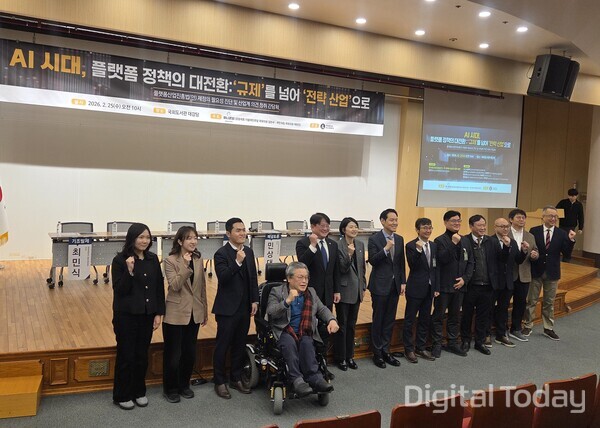
Unicorn Farm, a National Assembly research group focused on startups, held a forum on Tuesday at the National Assembly Library auditorium with the Startup Alliance under the theme, "AI era, a major shift in platform policy: Beyond regulation to a strategic industry." The forum examined the need to enact the Platform Industry Promotion Act and heard views from industry.
Choi Min-sik (최민식), a professor at Kyung Hee University's Graduate School of Legal Studies, who delivered the keynote presentation, said most of the 19 online platform-related bills introduced in the current 22nd National Assembly were drafted from a regulatory perspective. "Major countries recognize platforms as national assets and are putting in place legal systems to secure competitiveness," he said. "We also need a legal basis to foster the platform industry as a strategic industry," he added.
The bill was prepared by eight researchers at the Startup Alliance through a year of joint research. The draft consists of 19 articles. It includes special support for small and medium-sized enterprises (Article 10), startup 활성화 (Article 11), training of specialized talent (Article 12), support for technological innovation (Article 13), international cooperation and entry into overseas markets (Article 14), a basis for self-regulation (Article 18), and user protection and dispute resolution procedures (Articles 17 and 19). It also includes a provision (Article 5) linking it with related laws such as the Framework Act on Data and Artificial Intelligence.
Choi cited a decline in investment in platform startups as grounds for the need for a promotion bill. He said large-scale investments of 10 billion won or more fell to about half, from about 17 percent in 2021 to about 8 percent in 2023. "If investment sentiment weakens, opportunities to scale up are limited, and ultimately the entire platform industry could stagnate," he said.
Six figures from academia, industry and the government took part in a panel discussion. Seo Hee-seok (서희석), a professor at Pusan National University's law school, served as moderator.
Sun Ji-won (선지원), a professor at Hanyang University's law school, stressed that the target of platform promotion should not be platform companies themselves but the broader ecosystem mediated by platforms. The goal should be to build an ecosystem encompassing merchants on platforms, end consumers, and workers in delivery and ancillary services, he said. On self-regulation, he said that "the moment the government steps forward saying it will lead, the driving force of self-regulation is cut off," and that trust should be placed in voluntary private participation and market responses. He also said the bill's provisions on talent training, startup support and technological innovation would be effective only if they are not operated in a fragmented way but are linked organically within the broader framework of ecosystem building.
Jeon Seong-min (전성민), a professor in the business administration department at Gachon University, underscored a sense of crisis by citing that big tech accounts for about half of domestic internet traffic. He said Google's YouTube alone accounts for about 30 percent of domestic traffic, while Naver and Kakao together remain in the single digits. Jeon said the United States, China, the EU and Japan each pursue a state platform capitalism (SPC) strategy to protect their domestic platform industries, adding that "we also need a shift in perception to view platforms as national strategic assets." He pointed to what he described as an overt example of an SPC strategy, citing the Japanese government's pressure for changes to Naver's governance structure following the Line Yahoo incident.
Choi Hee-min (최희민), CEO of RapoLabs, who attended as a startup representative, said data is the core competitive strength of platforms in the AI era. "Global AI models will gradually converge upward," he said. "Ultimately, what matters is who has Korean consumer behavior data, and domestic platform companies are best at collecting and using this data," he added. On the relationship between platforms and small and medium-sized companies, he said early-stage startup platforms face difficulty bringing in big-company brands and are structurally forced to grow with small merchants and small brands, disputing the view that platforms are entities that suppress SMEs. On regulations governing settlement funds, he said self-regulation is working well and asked that even if regulation is introduced, autonomy be ensured in the selection of financial institutions and operating methods.
Han Seung-hye (한승혜), a research fellow at the Korea Internet & Security Association, introduced recent research findings that strong EU regulation of big tech is instead causing side effects across Europe's overall economic ecosystem, calling it "an example showing that strengthening regulation alone is not the answer." She said the spread of AI technology is shaking up the existing big tech-centered competitive structure, and that an enabling environment that responds flexibly to a changing market is more important than regulation premised on a fixed governance structure. On the bill, she proposed that "regulation should be flexible, and promotion should be designed elaborately so it does not remain at a declaratory level." On self-regulation, she added that effectiveness increases when it is designed to create an environment favorable to voluntary corporate participation.
Min Sang-dae (민상대), chairman of the Digital Small Merchants Federation, who attended as a representative of merchants on platforms, stressed that platforms play an incubator role for small business owners. "More than 95 percent of domestic business establishments are small firms with 10 or fewer employees, and platforms are becoming a channel for their startups and growth," he said. "Approaching platforms as a target of promotion rather than regulation becomes the foundation for small merchants' growth," he added. He also said platforms allow small merchants to use data accumulated on domestic services such as Naver, describing such a data-use environment itself as the basic stamina of small merchants in the AI era. He asked that shortening settlement cycles be clearly defined as regulation, not self-regulation, saying this part should be set by law to improve small merchants' cash flow.
From the government, Kwak Mi-kyung (곽미경), head of the digital platform team at the Ministry of Science and ICT, said the ministry also views platforms as a core part of AI infrastructure and believes promotion is more important than regulation. The ministry has operated a private self-regulatory body since 2022 with participation from eight platform companies including Naver, Kakao, Google, Baedal Minjok and Karrot, and has previously introduced a government bill to establish a legal basis in the Telecommunications Business Act to promote self-regulation. On the need for a separate platform promotion bill, she took a cautious stance, saying, "There are many provisions overlapping with existing laws such as the ICT Special Act on Convergence, so further discussions are needed." She acknowledged the need itself to discuss a separate promotion bill given that fair trade and monopoly-related regulatory laws alone cannot comprehensively cover promotion of the platform industry. She said the ministry is also reviewing preparations for a platform promotion bill on its own.
Kim Han-kyu (김한규), a lawmaker from the Democratic Party who attended the event, said, "There is an atmosphere in the National Assembly that regulation should be done first and promotion discussed later, but since platforms have already become inseparable from our lives, we should approach this in a way that simultaneously considers consumer welfare and minimizing side effects." Park Min-kyu (박민규), also of the Democratic Party, urged a solution through bipartisan agreement, noting that hundreds of amendments to laws are needed to use data for national AI infrastructure. Han Ji-a (한지아), a lawmaker from the People Power Party, said, "I hope the platform promotion law becomes the starting point for creating a ladder of opportunity for everyone."
The draft bill unveiled at the forum is expected to be continuously revised and supplemented after collecting opinions.
 Lee Ho-jung
lhj@d-today.co.kr
Lee Ho-jung
lhj@d-today.co.kr