
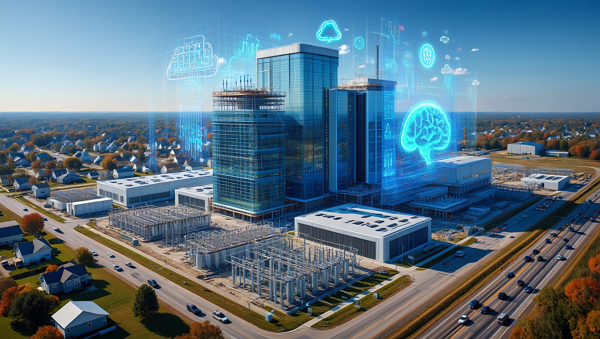
[Digital Today reporter Jinju Hong] As a boom in investment in artificial intelligence (AI) data centers intensifies, risks that the insurance industry and financial markets must shoulder are also growing quickly. As structures that concentrate massive sums in one place spread, analysts say new risks are emerging that are difficult to address with existing insurance and lending models.
On April 6, economic news outlet CNBC reported that Big Tech companies such as Microsoft, Google and Meta are actively using private equity (PE), private credit and debt financing to expand AI data centers. In the process, investment structures are becoming more complex and insurance and financial risks are becoming far more intricately intertwined than before, it said.
The market is already at a mega-scale. Consulting firm McKinsey projected global data center investment would reach about $7 trillion by 2030. Actual deals are also getting bigger. A consortium involving Nvidia, Microsoft, BlackRock and Elon Musk's xAI showed the market's scale by acquiring data center company Aligned for about $40 billion.
The first issue facing insurers is concentration risk. With assets worth billions of dollars, and in some cases more than $20 billion, being piled into a single site, situations are emerging in which insurers struggle to underwrite it all. An industry official said, "The facilities themselves are stable, but the problem is the scale," adding, "It is not easy to provide that much insurance capacity." In fact, until 2023 it was almost impossible to insure ultra-large data centers on reasonable terms, but projects of that size are now being discussed as a matter of routine.
The risks are not limited to buildings. Data centers combine real estate and advanced IT assets, making them difficult to assess under existing insurance systems. In particular, as more high-priced equipment such as GPUs is stored offsite before installation, risks must be considered even when the ownership and operating entities differ. If large facilities cluster in areas exposed to natural disasters such as hurricanes or strong winds, risk diversification becomes difficult and insurance costs can rise.
Financing structures are also becoming more complex. In the legal industry, AI data center investment is defined as a "mega project financed off the balance sheet," and concerns are being raised about a lack of transparency as funds worth trillions of dollars are deployed. Policy risks are also growing, with U.S. senators urging that Big Tech companies' complex debt structures should be investigated.
In particular, financing structures that use GPUs as collateral have recently emerged as a new point of contention. Data centers are assumed to operate for decades, but the lifespan of GPUs, a key piece of equipment, is only about 7 years. This creates a mismatch in which long-term assets and short-term assets are mixed. Some call it a "GPU debt treadmill" and say it could be structurally unstable because it requires continual equipment replacement and reinvestment.
Against this backdrop, cases have emerged in which funding is raised with GPUs as collateral. AI infrastructure company CoreWeave presented a new financial model by completing an investment-grade deal worth about $8.5 billion through GPU-based collateralized loans. Still, experts warn that as such structures spread, the potential for future disputes could also increase.
AI data centers are evolving into complex risk assets that test the limits of insurance and financial systems as a whole, beyond being technology infrastructure. Investment fever remains hot, but assessments say the risks that must be borne behind it are also growing quickly.
 Jinju Hong
hongjj@d-today.co.kr
Jinju Hong
hongjj@d-today.co.kr