
A claim was raised that it is urgent to form a pan-government committee to integrate and coordinate dispersed media policies in order to build K-content’s global achievements into domestic industrial competitiveness.
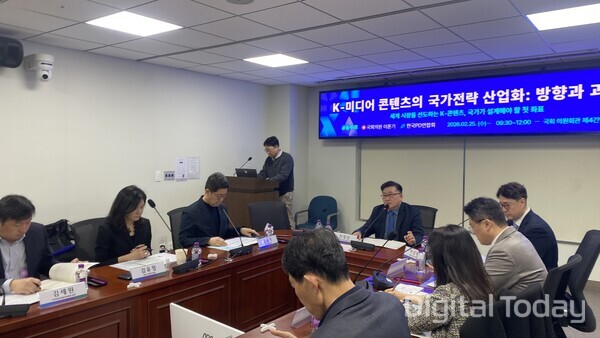
Sang-won Lee (이상원), a professor in the Department of Media Studies at Kyung Hee University who presented at a forum titled "K-media content as a national strategic industry: direction and tasks" held on Feb. 25 at the National Assembly Members' Office Building in Yeouido, said the biggest reason for failing to view platforms and content from an integrated perspective is the separation of ministries. He identified the absence of a media policy control tower as the key problem.
Lee pointed to a gap between K-content’s outward achievements and its internal reality, citing figures. Content exports have increased 4.2 times over the past 10 years, and the trade surplus has expanded 6 to 7 times. K-content accounts for about 7 percent of Netflix content, ranking second after the United States. But the details differ. Netflix holds the intellectual property for global hits such as "The Glory" and "Squid Game", there are no secondary revenue rights, and access to viewing data is not possible. Lee said production is important but the structure is such that global platforms never make concessions on IP and data.
The crisis in the domestic broadcasting industry is also deepening. Broadcasters' revenue has fallen by 600 billion won over the past 3 years, and broadcasting advertising revenue has dropped by 1.1 trillion won. Terrestrial broadcasters' operating profit fell to 84.5 billion won in 2024, with the rate of decline reaching 192.4 percent. The gap between broadcasting advertising and online advertising is expected to widen from 3.13 times in 2024 to 4.49 times in 2026, and three platforms, YouTube, Instagram and Facebook, account for more than 90 percent of the domestic video advertising market.
Lee cited policy dispersion as a structural cause of the crisis. Media-related policies are currently spread across three ministries, including the Korea Communications Commission and the Ministry of Science and ICT and the Ministry of Culture, Sports and Tourism. Some pay-TV functions were integrated with the launch of the Broadcast Media and Communications Commission, but OTT policy remains siloed. Lee said ministries are split and each works hard only on its own responsibilities, so things do not work. He warned that if the situation continues, matters the country will regret will arise within 3 to 4 years, or within 5 years at the latest.
As a solution, Lee proposed creating a "K-media national strategy committee to realize a cultural powerhouse." The idea is to create a control tower linked to the Prime Minister's Office or the presidential office to integrate and coordinate dispersed media policy functions. He said the Lee Jae-myung government's 123 national policy tasks already include establishing a public-private joint committee under the prime minister, so an institutional basis is in place. For funding, he proposed setting up a fund of 1 trillion to 2 trillion won combining government support with investment from financial institutions and the private sector.
The discussion also formed a consensus on the need for integrated governance. Yong-hee Kim (김용희), a professor in the Department of Business Administration at Sunmoon University, proposed upgrading the existing Content Industry Promotion Committee under the Content Industry Promotion Act into a "content industry strategy committee" by absorbing and expanding it, and placing the prime minister as chair. He said the three ministries alone cannot handle tax credits, export support and expanding foreign investment, and stressed the need for a pan-government system. Hye-seon Cheon (천혜선), a researcher at the Digital Industry Policy Research Institute, also said she hopes a venue will be 마련ed where matters including tax discussions can be addressed together by forming a working-level consultative body or a strategy committee.
Jeong-sang Ahn (안정상), a professor at Chung-Ang University who chaired the session, said the dispersion of ministries is the biggest obstacle. He concluded that forming a working-level consultative body first is a realistic starting point ahead of legislation.
The forum was jointly hosted by lawmaker Hoon-gi Lee (이훈기) and the Korea Producers and Directors Association, and was held with experts from academia and industry in attendance.
 Seulgi Son
sageson@d-today.co.kr
Seulgi Son
sageson@d-today.co.kr