
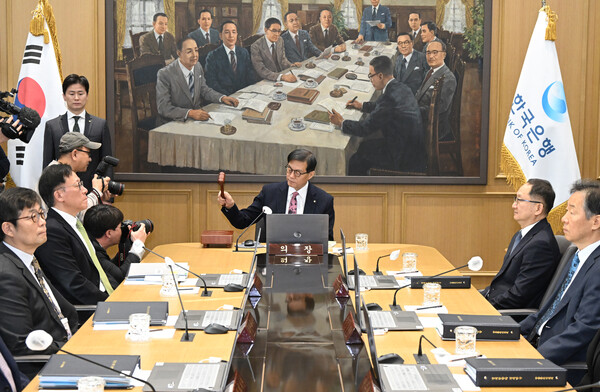
[DigitalToday reporter Ji-young Lee] A shock from high oil prices and a weak won has pushed domestic prices back up, putting the Bank of Korea’s monetary policy at a crossroads. A hold in the policy rate looks likely at the Monetary Policy Board meeting on the 10th, but there is a view that if supply-driven inflation pressure persists, the possibility of a rate hike in the second half of the year could become reality.
According to consumer price trend data recently released by the National Data Agency, March consumer prices rose 2.2 percent from a year earlier, extending a run in the low 2 percent range for a seventh month.
On the surface, the level looks stable, but the details differ. As higher international oil prices and a higher exchange rate combined, petroleum product prices surged 9.9 percent from a year earlier, and higher diesel fuel prices, up 17 percent, and gasoline prices, up 8 percent, lifted inflation. It marked the biggest increase since the 2022 spike in energy prices.
Rice prices rose 15.6 percent, and transport costs climbed 5 percent, posting the biggest increase in 1 year and 8 months. Personal services prices, including insurance premiums and management fees, also rose more than 3 percent, increasing the burden of living costs. Falling agricultural product prices and stability in processed food prices provided some cushioning, but there is an assessment that it is not enough to offset energy-driven inflation pressure.
The problem is that this supply-driven inflation pressure is likely only in its early stage. International oil prices have continued to rise, topping $100 a barrel in response to remarks by U.S. President Trump, and there is a view that even if the war ends early, it could take months for oil production to normalise. The won-dollar exchange rate, above the 1,500 won range, is also further stoking import prices.
The inflation path is likely to steepen after April. If current fuel price levels are maintained, the contribution of petroleum products to inflation would expand from March, and forecasts also say headline inflation could near 3 percent when indirectly affected items are included. If this coincides with the execution of a 26 trillion won supplementary budget, expected inflation could also face upward pressure.
In this situation, financial authorities have also moved to respond pre-emptively. To prevent the spread of a Middle East-driven shock, they have prepared a liquidity supply plan worth a total of 53 trillion won together with the financial sector, while also pursuing steps such as extending loan maturities and deferring repayments to support companies and ease the burden on ordinary people.
Monetary policy, however, is facing a more complex choice. Global investment banks are placing weight on the likelihood that the policy rate will be held at 2.50 percent at this meeting. Considering concerns about an economic slowdown and the execution of the supplementary budget, they judge it would be difficult to raise rates immediately.
The key issue is how long the high oil price and high exchange-rate situation will last. If the oil price spike is short-term, it is difficult to respond with interest rates, but if high oil prices and a high exchange rate become prolonged and lead to secondary inflation spillovers, a monetary policy response becomes unavoidable. A further burden factor is also cited in that the weak won has become pronounced, stimulating import prices and potentially pushing inflation up further.
In the end, this meeting is expected to make the message on the future policy direction more important than the rate decision itself. As it is Governor Chang Yong Rhee (이창용)'s final meeting, caution in communication with the market is likely to increase.
Choi Ji-wook (최지욱), a researcher at Korea Investment & Securities, forecast that "the Bank of Korea will carry out a policy rate hike in the second half of the year to prevent secondary spillovers from supply-driven inflation."
Kim Chan-hee (김찬희), a researcher at Shinhan Investment Corp, said, "A policy rate hold is likely at the April meeting, but as the monetary policy environment has changed with new variables such as oil prices and the exchange rate, judgments on the future path will be even more cautious." He added, "If changes in 'conditions' are emphasised in forward guidance, the market could take it in a hawkish way."
 Ji-young Lee
ljy@d-today.co.kr
Ji-young Lee
ljy@d-today.co.kr