
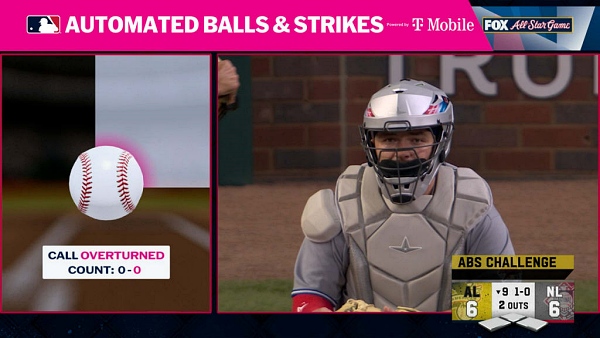
Major League Baseball’s (MLB) automated ball-strike system (ABS·Automated Ball-Strike), officially introduced from the 2026 season, is shaking up the sport from the first week of the season.
In the first four days, there were 124 disputes over calls in 35 games, and 67 of them, or 54 percent, resulted in overturns. Both MLB players and fans are quickly adapting to the system, which is being assessed as the biggest change in umpiring in baseball history.
According to foreign media including The Verge on Thursday local time, the ABS system works by having Hawk-Eye tracking technology using multiple cameras immediately issue a new decision when a batter, pitcher or catcher challenges an umpire’s ball-strike call.
Each team has 2 ABS reviews per game. If a review succeeds and the umpire’s call is overturned, the team keeps its ABS review opportunity. If the call is not overturned, the team loses that review opportunity. Only the batter, pitcher and catcher can request an ABS review. For ABS reviews, the top of the strike zone is set at 53.5 percent of a player’s height and the bottom at 27 percent, applied based on the center of home plate.
Early data are quantifying changes in how games play out. Average walks per team rose to 3.7 per game from 3.1 in the 2025 season. Because ABS changed the previous measurement method, the strike zone shrank by about 11 percent from last season, and umpires have become less able to readily call borderline pitches as strikes, it is analysed. The strikeout rate, at 22.1 percent, is nearly the same as last season.
By position, catchers have emerged as the sharpest requesters of ABS reviews. Catchers had a 58 percent success rate, higher than batters at 55 percent. Kansas City Royals catcher Salvador Perez (살바도르 페레스) led a league-high 5 overturns with a 71 percent success rate, and the New York Yankees’ Austin Wells (오스틴 웰스) went 4 for 4 on requests.
Differences in strategy by team are also clear. The Baltimore Orioles succeeded on 86 percent of 7 challenges, posting the league’s highest accuracy, while the New York Mets failed to secure a single overturn in 2 challenges.
The largest number of ABS review requests, 27, came at a 2-2 count. That shows players instinctively recognise high-pressure situations with large swings in expected runs. The ABS system’s effect on game pace remains a matter of debate.
MLB has cut average game time from 3 hours to about 2 hours 38 to 40 minutes by introducing the pitch clock, but some point to challenges increasing and games getting longer instead. MLB’s position is that based on early-season results, adjustments to the ABS system can reduce delays in game time.
 Hyunwoo Choo
cookinpapa@d-today.co.kr
Hyunwoo Choo
cookinpapa@d-today.co.kr