
A survey shows South Koreans are gradually shifting their main channel for consuming news from internet portals to video platforms.
Among traditional media, print newspaper readership hit a record low, while TV news use rebounded. Overall, news consumption is moving from "reading news" to "watching news."
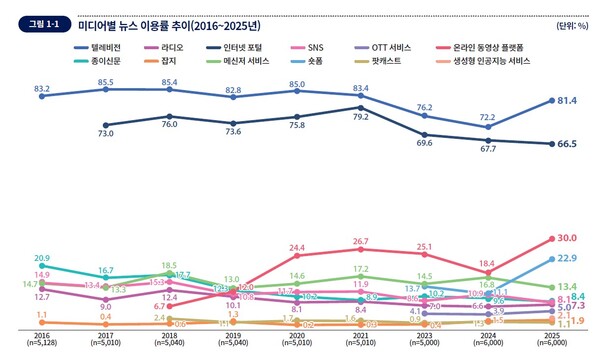
According to the Korea Press Foundation's "2025 Media Audience Survey" report released on Jan. 5, a survey of 6,000 adults aged 19 and older conducted by Korea Gallup from July to September last year found that 66.5 percent said they used internet portal news over the past week.
That was down 1.2 percentage points from the previous year's survey. It was the lowest since portal news use was first included in the annual survey in 2017. After peaking at 79.2 percent in 2021, it fell for a third straight year.
By contrast, news use via online video platforms surged 11.6 percentage points, to 30.0 percent in 2025 from 18.4 percent in 2024. By platform, YouTube dominated with a 92.2 percent share.
Short-form news use also jumped over the past year, to 22.9 percent from 11.1 percent.
Among traditional media, TV news use rebounded for the first time in 4 years, rising to 81.4 percent last year from 72.2 percent in 2024.
By contrast, print newspaper readership - the share of users who read at least 1 print newspaper article (including PDFs) over the past week - fell 1.2 percentage points from a year earlier to 8.4 percent, a record low.
Only 3.1 percent of people in their 20s and 4.2 percent of those in their 30s said they looked at a print newspaper over the past week. People aged 50 to 70 and older were relatively loyal print newspaper readers, but among those in their 50s, readership fell to 10.4 percent last year from 15.3 percent in 2024, showing a marked decline.
Average daily time spent reading print newspapers also fell for the first time in 4 years, to 28.5 minutes a day on average.
The report said overall news use rebounded last year amid the president's impeachment and an early election, and that the media driving the rise in news consumption were all video-based. It said this suggests a shift from "reading news" to "watching news" is gaining pace.
Meanwhile, news use via generative artificial intelligence stood at 2.1 percent, remaining low.
The survey also found trust in news and current affairs information rose 3.5 percent from a year earlier to 49.0 percent. Trust tended to be lower among younger age groups.
The most serious problems the media must address were cited as "clickbait articles," "abusing articles" (repetitive articles filed to increase clicks) and "biased articles."
[Yonhap News Agency]
 Online Team
d-today@d-today.co.kr
Online Team
d-today@d-today.co.kr