
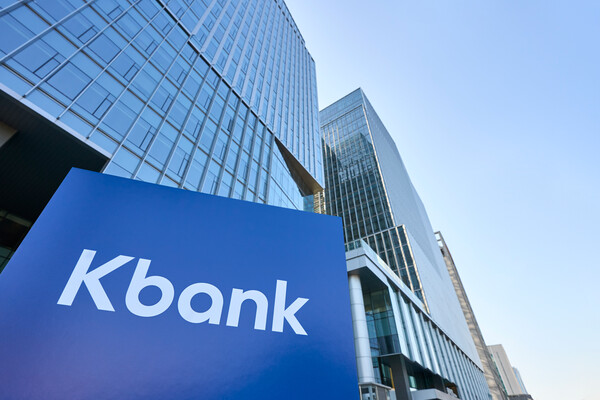
K Bank closes its public subscription for retail investors and lists on the KOSPI on March 5. K Bank raised nearly 9.85 trillion won in subscription deposits through the IPO, but assessments say it fell short of an explosive debut. Attention is now on the post-listing share price, which is expected to hinge on market trust in its supply-demand structure, earnings stability and growth potential.
The financial industry said on Tuesday that K Bank will list on the Korea Exchange's main board, the KOSPI, on March 5 and start trading after completing the retail subscription.
The retail subscription competition ratio was tallied at 134.6 to 1. A total of 2,374,120,000 shares were applied for against an allocation of 17,640,000 shares. There were 836,599 subscriptions, and subscription deposits totalled 9.85 trillion won, bringing in an amount close to 10 trillion won.
In the institutional bookbuilding held from Feb. 4 to Feb. 10, 2,007 institutions at home and abroad took part and applied for 6,550,000,000 shares. The competition ratio was about 199 to 1, and the order size was about 58 trillion won.
A representative of the lead underwriter said institutional interest confirmed in the bookbuilding carried into the retail subscription. The representative said the outcome reflected trust in its growth potential and business model.
The offer price was set at 8,300 won, the bottom of the indicated range of 8,300 won to 9,500 won. The implied market capitalisation after listing is about 3.37 trillion won.
Conservative strategy cuts valuation, but big-ticket status in doubt
K Bank is South Korea's first internet-only bank, launched in 2017. It has been assessed as having grown in scale through lending-focused growth and platform expansion. But after two failures, it set a lower valuation in this listing than past expectations.
The offering size was reduced to 60 million shares from an initial 82 million. Compared with expectations of a market capitalisation in the 5 trillion won range that were discussed when it pursued a listing in 2024, the projected value this time fell to the 3 trillion won range.
The upside from the offer price appears already reflected in the over-the-counter market. Based on 38 Communication, the over-the-counter price is 12,750 won, about 41.6 percent above the offer price. That has led to an interpretation that the offer price was set conservatively. It also changed its peer group from Japan's SBI Sumishin Net Bank to Rakuten Bank, reducing valuation 부담.
A simple comparison is difficult, but KakaoBank, which listed in 2021, drew nearly 58 trillion won in subscription deposits in its retail offering. In institutional bookbuilding, it posted a competition ratio of 1,733 to 1, recording a so-called record-breaking debut. Competition among institutions to secure allocations was also intense.
But the bookbuilding system has since been revamped so institutions must pay the actual offering amount, making a simple comparison with past ratios difficult. Even taking into account that KakaoBank listed during a boom in IPO subscriptions, the prevailing assessment is that K Bank's institutional and retail results are at an average level. Critics say it is somewhat lacking to be called a big-ticket IPO.
Some companies in the IPO market around the same period posted better bookbuilding results than K Bank. Axvis, described as a global laser solutions company, recently recorded an institutional competition ratio of 1,124 to 1, with 2,411 participation cases, exceeding K Bank. Its offer price, unlike K Bank's, was set at the top of the indicated range.
Outlook even points to '8,000 KOSPI' as financial stocks rise
Market conditions are cited as a variable. South Korea's stock market has maintained a strong rise so far this year. Some in the securities industry are even presenting forecasts for "8,000 KOSPI", meaning a KOSPI level of 8,000.
In addition, financial stocks have generally shown strength as expectations for increased dividends based on record earnings align with expectations for stronger shareholder returns, including discussions on separate taxation of dividend income.
Shares of major financial holding companies, including KB Financial Group, Shinhan Financial Group, Hana Financial Group and Woori Financial Group, have continued to rise. KakaoBank, the leading internet-only bank stock, has also maintained a steep rise since the start of the year after posting record-high earnings.
Such an environment could act favourably on K Bank's share price trend after listing, according to an analysis.
That is because KakaoBank shares are getting a strong boost, raising expectations for a re-rating of the broader internet bank sector.
Ultimately, K Bank's share price after listing is expected to depend on whether it merely holds the offer price level or gains a "sector premium" by riding the tailwind of the stock market rally.
K Bank CEO Woo-hyung Choi (최우형) said the company will step up investments for future growth through the IPO proceeds, including entering the SME market, building a platform business foundation, and new businesses such as digital assets. He thanked all investors who participated, saying they trusted K Bank's differentiated competitiveness and growth potential. He said the bank will accelerate innovative finance and do its best to enhance shareholder value through steady growth.
 Ji-young Lee
ljy@d-today.co.kr
Ji-young Lee
ljy@d-today.co.kr