
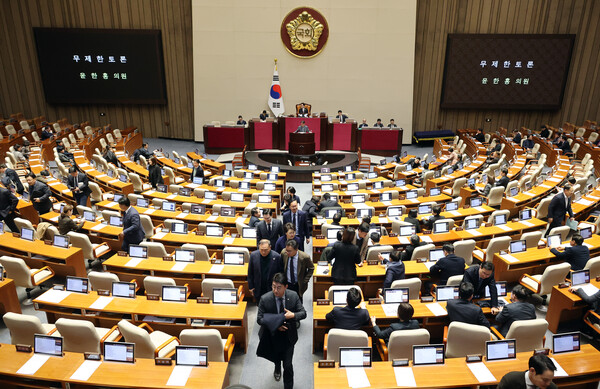
A third revision to the Commercial Act that would require companies, in principle, to cancel treasury shares was introduced at a National Assembly plenary session on Monday. The revision, pushed by the Democratic Party, is expected to be put to a vote on Tuesday afternoon after the People Power Party requested a filibuster.
The National Assembly held a plenary session on Monday afternoon and introduced the third Commercial Act revision, centred on improving the structure of the finance and capital markets. The revision, proposed under the Democratic Party’s lead, stipulates as a principle that if a company acquires its own shares, it must cancel them within 1 year.
Companies subject to limits on foreign investment under the Telecommunications Business Act and other laws must, in principle, dispose of their own shares within 3 years from the effective date, to the extent necessary to comply with laws and regulations.
If certain reasons are recognised, such as employee compensation or the operation of an employee stock ownership scheme, an exception to the cancellation obligation can apply if a holding and disposal plan signed and sealed by all directors is approved each year at a shareholders meeting.
However, industry calls to recognise an exception to the cancellation requirement for treasury shares "acquired involuntarily", such as through mergers and acquisitions or a shift to a holding company structure, were not accepted.
The People Power Party is strongly opposing the revision, saying it could expose domestic companies to hostile attacks by corporate raiders. It says the cancellation of treasury shares should not be made uniformly mandatory in order to secure minimum means of defending management control.
The People Power Party requested a filibuster as soon as the bill was introduced, and lawmaker Yoon Han-hong (윤한홍) spoke first against it. The party plans to use a full-scale, seven-night, eight-day filibuster through March 3, when the February extraordinary session ends, to highlight what it calls the unfairness of the Democratic Party passing the bill on its own.
The Democratic Party, on the other hand, says mandatory cancellation of treasury shares is needed to address the "Korea discount". Under National Assembly rules, debate can be forcibly ended 24 hours after the start of a filibuster with the support of three-fifths of sitting lawmakers, and the party plans to end the filibuster on Tuesday afternoon and press ahead with a vote.
As passage of the third Commercial Act revision became more likely, domestic companies moved to dispose of treasury shares before the rules take effect. The Korea Capital Market Institute said 25.3 percent of listed companies’ disclosures on treasury-share disposals last year were concentrated in December alone.
From January to November 2025, monthly average disclosures on treasury-share disposals were 43.9 cases, but they surged to 164 cases in December alone. More than half of the December disposal volume, 55.5 percent, was carried out for a specific individual or a specific company.
Hwang Hyun-young (황현영), a research fellow at the Korea Capital Market Institute, said this showed there was a significant incentive to use treasury shares to stabilise control or restructure succession arrangements ahead of the institutional change. He pointed out that disposing of shares to the children of a controlling shareholder could raise issues of an irregular transfer of management control, and cases of creating friendly shareholders by issuing exchangeable bonds could also be problematic.
 Sangyeop Oh
yub@d-today.co.kr
Sangyeop Oh
yub@d-today.co.kr