
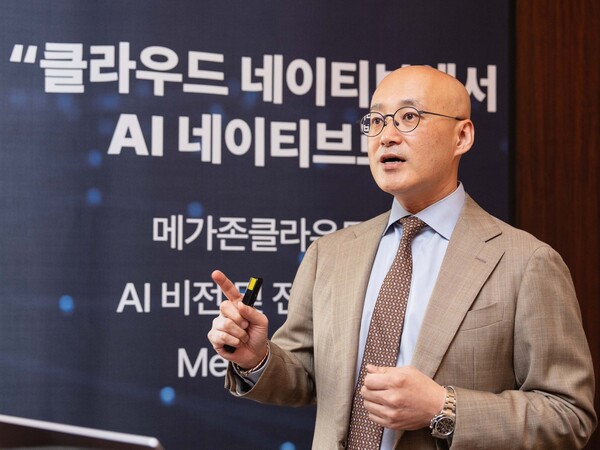
Yeom Dong-hoon (염동훈), chief executive of MegazoneCloud, highlighted 2 factors for AI to take root in workplaces: an enterprise trust layer and change management. He presented a vision of a scenario in which all employees use cloud-based AI computers.
In a keynote speech at the ICON2026 conference MegazoneCloud held on Wednesday with global partners, Yeom said the enterprise market cannot be addressed by technology alone. He said AI can spread in the enterprise market only when building a trustworthy environment is combined with efforts at the company level to encourage and manage employees' use of AI at work.
Yeom cited cost and the adoption environment as prerequisites for new technologies to become mainstream. "There are many cases where even great technology failed to become popular," he said. "The metaverse emerged as if it would change the world during COVID but quickly lost its presence. Apple Vision Pro was also recognised for its technology but failed to overcome the price barrier." He said AI, too, must be able to answer whether an environment exists in which companies can actually use the technology.
The reality is not easy, he said. Citing a McKinsey survey, Yeom said only 7 percent of companies generate large-scale value from AI, while the remaining 93 percent have yet to cross the 'enterprise AI chasm.'
He also cited inadequate management of which AI employees use and how they use it as an obstacle.
In a recent MegazoneCloud survey of about 600 corporate officials, 86 percent said they use AI services not approved by their companies. Yeom said a phenomenon similar to the spread of "shadow IT" seen in the early days of cloud adoption is also occurring with AI.
"The behaviour of paying for and using cloud services with personal cards without company approval is now being repeated in the AI space," Yeom said. "If this situation is left unattended, problems will arise." He said if information is leaked through the use of unauthorised generative AI services, companies would make an extreme choice to block them entirely. That would remove the opportunity to use good technology and lead to a vicious cycle of falling behind in competition, he said.
He said this means AI will struggle to move beyond the pilot stage in the enterprise market unless an enterprise trust layer and change management are ensured.
The enterprise trust layer is about governance, security and compliance, Yeom said.
Governance defines rules for using AI. It covers decisions such as whether a marketing team can analyse financial information with AI, or whether a customer service AI agent should have the authority to cancel orders.
Security is the technology that can actually enforce the rules. The core is ensuring AI agents operate only within permitted boundaries. Compliance is a system to confirm adherence to government laws and regulations.
"To use various AI services safely in companies, including Google Gemini Enterprise, Amazon Q, Microsoft Copilot and OpenAI ChatGPT Enterprise, an enterprise trust layer must be in place," Yeom said. At the event, MegazoneCloud unveiled its enterprise AI OS, AIR Studio V2, designed to integrate management of the entire process from building AI to execution and control as an enterprise trust layer.
MegazoneCloud launches enterprise AI OS AIR Studio V2
Building technical infrastructure alone has limits in spreading AI in enterprise environments. Citing MegazoneCloud as an example, Yeom said the company bought and distributed Gemini licences to employees last year, but most were not using them a month later. After running a systematic change management programme for 6 months, 60 percent of employees began using Gemini daily, he said. "It is difficult for AI adoption to succeed without change management," he said. "Employees need to know why they should use it and receive proper training on how to use it for the investment to bear fruit."
Yeom said agentic AI has the potential to lead a new vision in the tech paradigm.
He said Bill Gates presented the vision of "a computer on every desk and in every home," and Steve Jobs opened the smartphone era with the vision of "a computer in everyone's pocket," adding that a next vision is now needed. He raised "a cloud-based AI computer for every employee" as a new theme. "We will have to see over time whether it will happen, but the current flow is moving in that direction," he said.
 Chi-gyu Hwang
delight@d-today.co.kr
Chi-gyu Hwang
delight@d-today.co.kr