
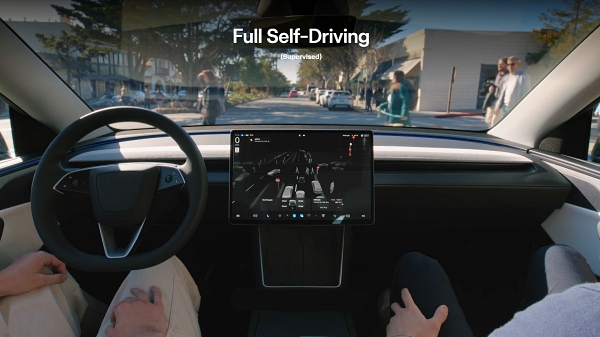
[DigitalToday reporter Jinju Hong] Tesla is beta-testing the latest version of its autonomous driving software, Full Self-Driving (FSD) v14.3, with employees. The company may move to a broad rollout as early as this week. Expectations for new capabilities are rising, while performance disputes seen in recent updates and regulatory risks are also coming into focus, drawing market attention.
Elon Musk (일론 머스크), Tesla's CEO, said on X, formerly Twitter, that FSD 14.3 is currently running as an employee beta and that a broad rollout could take place around the end of this week, Electrek reported on Tuesday local time.
Version 14.3 is the release Musk has described as a turning point since late last year. He has previously said the update would fit in "the last big piece of the puzzle" and suggested it would feel as if the vehicle has consciousness.
The core of the update can be summed up as expanding the scale of the neural network and improving inference and reinforcement-learning capabilities. It also targets improvements in navigation routing quality, which users have repeatedly complained about, and stronger responses in complex urban environments. Still, since the changes were presented at an expected level, whether performance actually improves will need to be verified after the official rollout.
Rollout targets vary by hardware generation. Version 14.3 will first be applied to vehicles equipped with the latest HW4 (Hardware 4), while HW3 vehicles will receive a separate lightweight version called 'FSD v14 Light'. The release timing for that version is expected in mid-2026, raising the possibility of a perceived gap among users.
Mixed reactions from the market and users reflect disputes over the performance of the previous version. The outlet said that assessments of the v14.2 series update "are split even at best." Some updates added features such as school-zone speed compliance and animal detection, but criticism continued over so-called regression effects, including turn-signal malfunctions and ignoring navigation instructions.
Reliability indicators also fell short of expectations. Average driving distance until a "critical disengagement" appeared to improve at one point to around 2,000 miles, about 3,218 km, but later moved closer to around 1,000 miles, about 1,609 km, as more data accumulated, an analysis said. Reviews also followed that driver intervention occurs every few dozen miles in city driving.
Regulatory risks are also growing. The U.S. National Highway Traffic Safety Administration recently upgraded its probe into an engineering analysis, citing the possibility that the FSD system may not respond appropriately in reduced-visibility conditions such as sun glare, fog and airborne dust. The number of vehicles covered by the probe was expanded to about 3.2 million, a step typically considered one stage before a recall.
NHTSA believes a camera-based system may not be sufficient to detect performance degradation and warn drivers when visibility is obstructed, and it is also looking into the possibility that related accident reports were counted lower than the actual number. The number of crashes under review also rose to 9 from 4, and one fatal crash was included, the report said. A separate probe related to traffic-signal violations is also under way.
The industry sees v14.3 as a test bed that will gauge the credibility of Tesla's autonomous driving technology beyond a simple feature update. With FSD still a Level 2 assistance system that requires constant driver supervision, safety in real driving conditions and consistent performance improvements are expected to be key evaluation criteria.
 Jinju Hong
hongjj@d-today.co.kr
Jinju Hong
hongjj@d-today.co.kr