
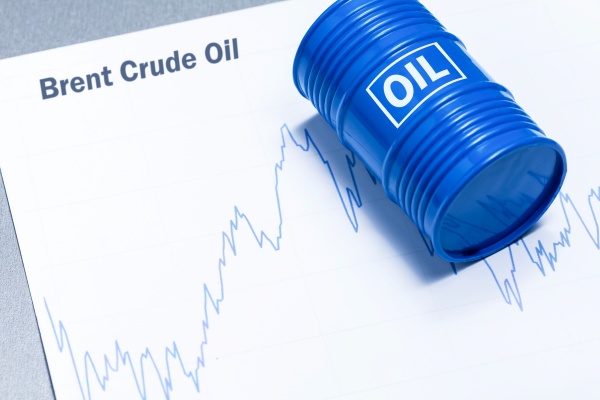
[DigitalToday reporter Jinju Hong] Brent crude futures rose more than 60 percent over March, posting the biggest monthly gain since 1988, blockchain media outlet BeInCrypto reported on Tuesday local time.
May Brent settled at $118.35 a barrel, up about 5 percent from the previous day. U.S. benchmark West Texas Intermediate (WTI) also rose about 51 percent in March, marking its strongest monthly performance since May 2020. On a monthly basis, both crudes underwent a sharp price re-rating.
The key driver behind the surge was identified as the closure of the Strait of Hormuz. According to the outlet, Iran closed the strait after a joint U.S. and Israeli air strike on Feb. 28. The International Energy Agency (IEA) described the disruption as the largest turmoil in the history of the global oil market.
The impact is also spreading to consumer prices. U.S. gasoline prices rose $1.25 a gallon since December to $4 a gallon, which was cited as the highest level since 2022. In Britain, gasoline prices rose to 152.8 pence a litre, up about 20 pence from when the conflict began.
Market participants see the risk of a prolonged closure as the biggest threat. Bruce Kasman (브루스 카스만), head of global economics at JPMorgan, warned that a scenario in which the Strait of Hormuz closure lasts one more month "is consistent with oil rising to around $150 a barrel and constraints emerging in industrial consumers' energy supplies." Bloomberg reported that U.S. government officials and Wall Street analysts have begun discussing the possibility of oil reaching $200 a barrel.
Messages are also mixed over a political and military solution. The outlet said U.S. President Donald Trump mentioned that operations in Iran could be wrapped up within 2 to 3 weeks. The Wall Street Journal (WSJ) also reported that Trump told aides, "I am willing to end the military operation even if the Strait of Hormuz remains mostly closed." It added that the United Arab Emirates (UAE) is preparing to support the United States in reopening the waterway by force.
Ultimately, whether oil rises further or stabilises appears to depend on how, and in what order, the Strait of Hormuz issue is resolved.
 Jinju Hong
hongjj@d-today.co.kr
Jinju Hong
hongjj@d-today.co.kr