
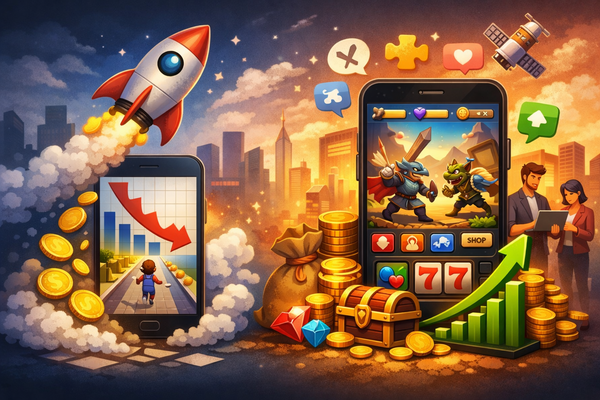
Hybrid casual is emerging as a new growth engine in the mobile game market. As hyper casual games that spread rapidly in the mobile market reach saturation and profitability weakens, hybrid casual titles designed to address those limits are gaining traction. Major South Korean game companies are one after another declaring plans to enter the segment.
Hyper casual games lowered barriers to entry with simple controls and intuitive rules, attracting a broad user base. But their revenue structure was tied to a single model of in-app advertising.
Revenue did not rise in proportion even as downloads increased, and repeated criticism said frequent ad exposure hurt the user experience. The industry’s assessment is that the mobile game landscape is shifting to the point that hyper casual games are themselves moving toward hybridisation due to intense competition.
Hybrid casual games were designed to target these structural flaws. They keep hyper casual’s simple controls but combine elements such as collecting, RPG and storylines to encourage long-term retention. Their revenue structure also shifts to a two-track approach that uses both in-app ads and in-app purchases, lowering reliance on advertising and diversifying revenue sources. The longer users stay, the higher the likelihood they convert to paying users, linking engagement design directly to profitability.
MARKET SEEN AS PROFITABLE; SUCCESS STORIES EMERGE
Hybrid casual profitability has already been confirmed in figures. According to global mobile app analytics firm AppMagic, as of September last year, in-app purchase revenue for hybrid casual games on Google Play and the App Store rose 93 percent and 84 percent, respectively, over one year.
In South Korea, Supercent has produced a success story. Cumulative downloads for "Pizza Ready" topped 400 million, and it won a "$100 million export tower" award late last year on the back of the popularity of hybrid casual titles such as "Snake Clash".
According to app analytics firm Sensor Tower, Supercent ranked 7th in downloads among global mobile game distributors in 2025. That was an unusual achievement for a South Korean game company over the past 10 years. Since its establishment in 2021, Supercent has focused only on casual games to deliver the result.
Market forecasts also support the trend. According to Samsung Securities, the global casual game market is projected to expand to $35.7 billion (53.8 trillion won) by 2032 from about $18.4 billion (27.7 trillion won) in 2025. With domestic market growth stagnating, the casual game genre’s lack of dependence on specific languages or cultural spheres, which makes localisation burdens relatively low, is also cited as a factor drawing large companies.
NC, NEPTUNE TARGET MARKET IN DIFFERENT WAYS
Large game companies are also moving into the hybrid casual market. NCSoft, known for "Lineage", officially set out plans to enter the casual game market, including hybrid casual, by establishing a mobile casual division last year. It aims to diversify a game lineup tilted toward MMORPGs and target a broad global market, including the West.
NC secured a series of mobile casual studios at home and abroad, including LiHuHu, SpringComz and Moving Eye, to broaden its portfolio. It also acquired casual game platform JustPlay to build a foundation to operate an ecosystem. At a shareholder meeting held on March 26, it formalised expansion of its mobile casual game business as one of three key pillars.
The company that has narrowed its focus most clearly to hybrid casual is Neptune, a KRAFTON subsidiary. Neptune launched a hybrid casual-focused publishing brand, "Flick", on March 26 and formalised hybrid casual publishing as one of three new growth businesses. It completed internal reorganisation by absorbing and merging its unit Tripla early this year and establishing a dedicated division.
It also invested in specialist developer Albus, whose two flagship titles reached 40 million global cumulative downloads within 2 years of launch. "Dig and Roll", being developed by Peb, a developer that received investment from Crit Ventures, has also completed a publishing agreement with Tripla and is set for release in the first half of this year.
Neptune’s claimed differentiator is integration with its existing adtech business. It aims to maximise in-app revenue by applying advertising technology to user traffic secured through hybrid casual games. Neptune said it would "build a sustainable publishing pipeline, not a one-off event."
An industry official said, "Hybrid casual looks easy, but the key is the ability to design gameplay that keeps users for a long time." The official said, "Even if you enter by putting capital and brand up front, in the end the experience of teams that have handled the genre for a long time will be the standard that decides wins and losses in the market."
 Ho-jung Lee
lhj@d-today.co.kr
Ho-jung Lee
lhj@d-today.co.kr