
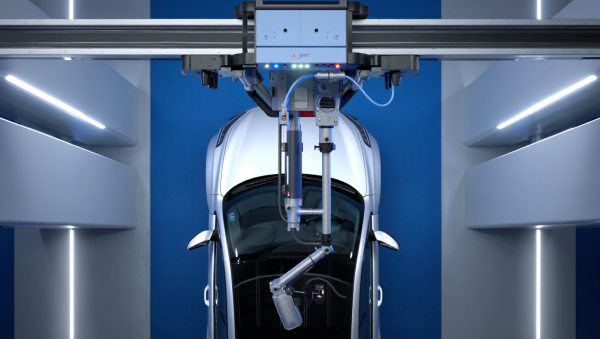
China is stepping up innovation in EV charging infrastructure. Videos recently shared on social media platforms such as Weibo show charging robots moving along ceiling rails in underground parking lots in several Chinese cities. When users request charging via a QR code or a WeChat mini program, a small robot moves above the vehicle and automatically connects a connector. The setup means every parking space becomes a potential charging point, without the need to find a dedicated charging area or wait.
Electrek, an EV outlet, reported on Feb. 23 that the biggest advantage of the system is cost efficiency. A single rail network can cover multiple spaces instead of installing a charger at each parking bay.
Several companies are competing to commercialise overhead rail-style charging systems. Chinese EV maker Li Auto and CGXi, a developer of high-speed collaborative robots for vehicles, are developing a rail-based unmanned charging system. U.S. convenience store and gas station chain Wawa said that with the 'HAVA robot' under its own charging brand, Wawa Charging, a single charger unit can serve more than 8 parking bays.
In academia, a rail-mounted EV charging robot system called SkyvoltRobot, documented in a 2024 ScienceDirect paper, has provided the theoretical basis for today's commercial deployments.
Charging speed has limits. The method is based on Level 2 AC, making it hard to compare with BYD's 1,000-kilowatt ultra-fast DC charger. It is instead seen as suitable for office, shopping mall and apartment settings where cars are parked for long periods.
China's mobile charging robot market is growing fast. Companies including CharGo, a subsidiary of CATL, as well as NaaS, GGSN and VMR, are expanding ground-moving robots. Forecasts also say 20 percent of all EVs in China could be charged by robots by 2030. China already has 31.4 million EVs and 14.4 million charging points, but it still has only 1 charger for every 2.2 vehicles. Mobile and ceiling-mounted solutions are emerging to make up for this structural constraint.
The United States is also responding. Westfalia Technologies has launched a 50-kilowatt overhead gantry-based system called WEPLUG, and Gravity installed a 500-kilowatt ceiling-mounted charger in New York. But while the West remains at the pilot stage, China has already entered a commercialisation phase, marking a large difference.
China, which rapidly expanded EV adoption, is now changing charging methods themselves and seeking market leadership again.
 Jinju Hong
hongjj@d-today.co.kr
Jinju Hong
hongjj@d-today.co.kr