
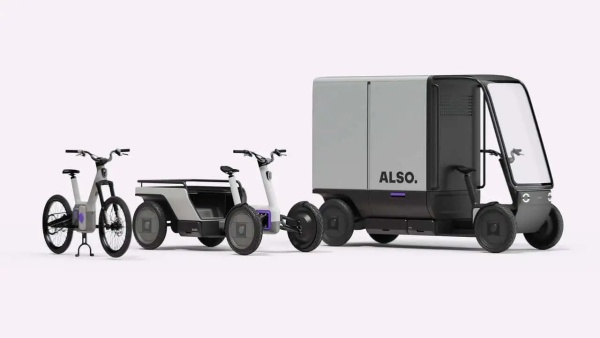
Micromobility startup Also, spun off from Rivian, is joining hands with U.S. food delivery company DoorDash to develop an autonomous delivery vehicle.
TechCrunch reported on March 31 that the two companies agreed to jointly pursue an autonomous model based on Also’s small electric delivery platform.
The partnership goes beyond a simple technology tie-up to link capital and governance. DoorDash not only participated in Also’s $200 million Series C funding round but also secured a board seat. Greenoaks Capital led the round, taking Also’s cumulative funding to more than about $500 million and valuing the company at more than $1 billion.
Also began in 2022 as an internal skunkworks project at Rivian. It initially aimed to develop electric bicycles but later expanded into small pedal-assist delivery vehicles. The company has emphasized that the vehicle is small enough to enter bike lanes while carrying more than 400 pounds, or about 180 kg, of cargo.
The market interprets the collaboration as a signal that Also is moving toward autonomous driving. TechCrunch assessed the deal as the first clear milestone indicating that Also is developing an autonomous version of a small electric vehicle. RJ Scaringe and Also Chief Executive Chris Yu (크리스 유) have also left open the possibility of various vehicle formats in past interviews.
The source of autonomous-driving technology, a key variable, remains uncertain. There is speculation that Also could use Rivian’s technology stack, but it is unclear whether autonomous-driving systems will in fact be shared. Rivian is developing an autonomous-driving system that combines cameras, radar, ultrasonic sensors and, in the future, lidar. It is also building its own custom semiconductors and computing platform.
Another scenario is that DoorDash takes the technological lead. DoorDash has been developing its own autonomous robot, Dot, which is designed to operate on roads, bike lanes and sidewalks based on lidar, radar and cameras. It is also running real delivery tests in some parts of the United States at a top speed of about 20 miles per hour, or about 32 km per hour.
The tie-up shows that the last-mile delivery market is rapidly being reshaped around autonomous driving and small electric vehicles. If DoorDash’s operational experience and autonomous-driving capabilities are combined with Also’s lightweight electric platform, the market has raised the possibility that it could create a cost structure and efficiency different from existing delivery models.
A key point to watch is who will lead on autonomous-driving technology. The core variable is whether it uses Rivian’s technology, applies DoorDash’s in-house system, or takes a hybrid approach. With DoorDash also securing a board seat, the market is expected to focus on how the product roadmap and commercialisation strategy are detailed.
 Jinju Hong
hongjj@d-today.co.kr
Jinju Hong
hongjj@d-today.co.kr