
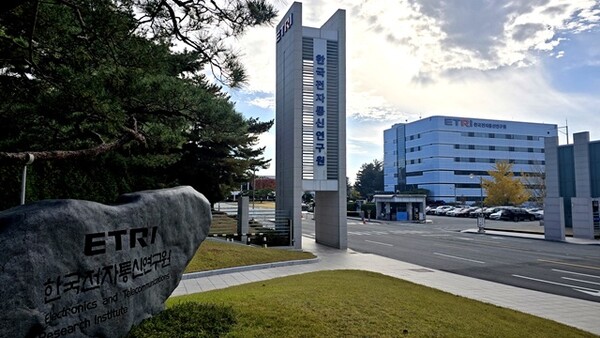
The Electronics and Telecommunications Research Institute (ETRI) marked its 50th anniversary.
ETRI held a ceremony on Tuesday at its headquarters in Daejeon to mark the anniversary, reviewing ICT research and development achievements over the past half-century and presenting a vision for the next 50 years. The event was attended by Ryu Je-myung (류제명), second vice minister of the Ministry of Science and ICT, Yang Seung-taek (양승택), a former minister of Information and Communication, former heads of the institute and other guests.
The event began with a screening of a 50th anniversary video, followed by commemorative remarks by President Bang Seung-chan (방승찬), video congratulatory messages from lawmakers, awards for special contributions by former institute heads, staff awards and a publication ceremony for a 50-year history book.
Since its establishment in 1976, ETRI has developed key ICT technologies including the TDX electronic switching system, DRAM memory semiconductors, CDMA digital mobile communications, 3G and 4G mobile communications systems and artificial intelligence, driving domestic industry and economic development. TDX in particular is evaluated as the starting point for self-reliance in telecommunications technology and became a driving force for later DRAM and CDMA development.
Its research achievements also had large industrial ripple effects. ETRI said industrial and economic ripple effects created over the past 50 years total about 494 trillion won. Of that, effects from representative core technologies were analysed at 316 trillion won, while other industry diffusion effects were 178 trillion won. ETRI also said it contributed to strengthening the competitiveness of the domestic ICT industry by developing world-class technologies such as LTE mobile communications, OLED displays and voice-recognition AI.
ETRI said it continues to deliver results in research capabilities as well. It holds 1,312 international standard patents. Patent royalties over the past 3 years total 131.3 billion won. In the Ministry of Science and ICT's "100 Best National R&D Achievements", ETRI recorded a cumulative 170 selections, with the largest number among government-funded research institutes for 7 consecutive years. It also received top grades in both research project evaluations and institutional management evaluations.
A special programme marking the 40th anniversary of the launch of TDX was also held. Attendees watched related videos and took part in a digital pledge ceremony on "defending AI sovereignty". A ceremony unveiling a 50th anniversary monument followed.
This year's ETRI Researcher Award went to Hye-jin Kim (김혜진), a principal researcher at the Intelligent Components and Sensors Research Section of the Artificial Intelligence Creative Research Laboratory. Kim was recognised for developing a technology that implemented the world's first 360-degree omnidirectional tactile sensor in the form of a robot finger and for contributing to strengthening industrial competitiveness through technology transfer and commercialisation.
ETRI President Bang said, "ETRI has laid the foundation for national economic development over the past 50 years." He added, "In the coming half-century, it will become the main player responsible for South Korea's future by creating advanced research outcomes that benefit the world."
 Jin-ho Lee
jhlee26@d-today.co.kr
Jin-ho Lee
jhlee26@d-today.co.kr