
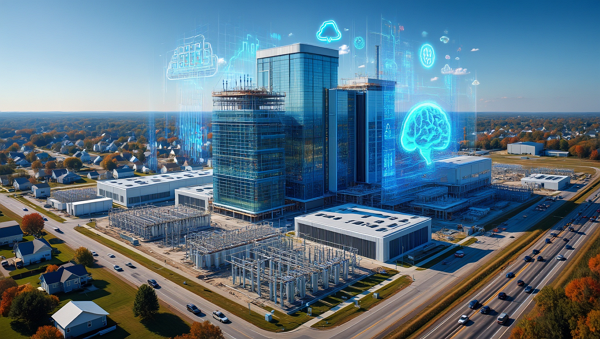
As electricity demand from the artificial intelligence industry surges, energy policy, supply chains and financial markets are being shaken at the same time.
Cryptopolitan reported on March 31 that grid connection delays are lengthening as data centres spread, while concerns have grown over geopolitical risks and worsening investment returns.
Sam Altman (샘 알트먼), OpenAI's CEO, said the company "needs 1 gigawatt (GW) of power every day". The scale highlights AI's power needs given the United States added about 53 GW of new generating capacity over the past year.
Investment is also underway on a large scale. Amazon, Microsoft, Alphabet and Meta are expected to invest about $630 billion in data centres and chips in 2026. The total rises to $811 billion when seven cloud and infrastructure companies are included. The four companies operate about 600 data centres worldwide, and 544 are in planning or under construction.
The bottleneck comes after construction, in bringing facilities online. A latest 100 megawatt (MW) AI data centre costs more than $4 billion, with about 70 percent of that for servers and processors. But in big cities such as London, a grid connection can take up to 10 years. Companies are moving to places such as parts of Texas in the United States where permits are easier, but there have also been cases in which they supported building communities for employee housing due to a shortage of skilled workers.
Supply chain pressures have also grown. In Europe, transformer delivery times have extended to as long as 100 weeks, and about 60 percent of data centre projects last year were delayed by more than three months. Some 88 percent ran into problems at the concrete foundation pouring stage, while installing cooling systems and fire alarms was also cited as a cause of delays for 78 percent. Nvidia's Blackwell and next Rubin architecture chips are running hotter, accelerating a shift from air to liquid cooling, and adoption of solid-state transformers is also increasing to handle the power demand of next-generation server racks.
Instability in the Middle East is an additional variable. With many data centres reliant on diesel generators for emergency power, concerns have been raised that fuel supplies could be threatened. Melissa Otto (멀리사 오토) of S&P Global Visible Alpha warned that if oil prices stay high for a prolonged period, the stock market could face a sharp correction.
Returns compared with infrastructure investment are also expected to fall. Alphabet's return on invested capital (ROIC) is projected to decline to about 36 percent in 2030 from 51 percent last year, and Microsoft's is expected to fall to 36 percent in 2030 from 95 percent in 2020.
Some experts say it is more important to use spare capacity in existing power grids more efficiently than to expand power plants. Power grids in major Western countries run at an average utilisation rate of about 30 percent and reach their limits for only about 100 hours a year. Managing that could secure an additional 100 GW without new generation, the analysis said.
GridCARE and Portland General Electric are testing a method that uses AI to forecast renewable output and move data centre workloads to times and places where power is plentiful. The analysis found that if a 1 GW data centre uses grid capacity during off-peak periods, it could cut electricity bills for ordinary consumers by up to 5 percent.
 Jinju Hong
hongjj@d-today.co.kr
Jinju Hong
hongjj@d-today.co.kr