
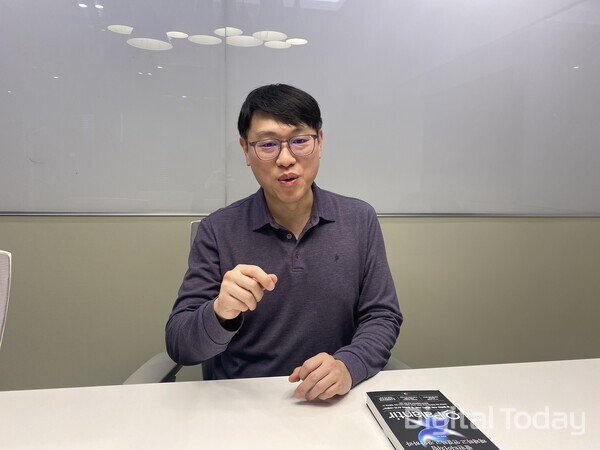
"It is impossible to build ontology technology like Palantir Foundry in a short period, but it is feasible in specialised areas."
Attorney Kwan-young Jung (정관영), author of the book "Dismantle, Connect and Dominate Like Palantir," said this as he shared his experience applying ontology, regarded as a core technology of U.S. big data company Palantir.
Ontology is a knowledge structure that systematically defines concepts in a field and their relationships. It is known as a core technology of Palantir Foundry, Palantir's big data platform. Jung said he encountered ontology while running legal tech startup RawData and felt its potential as he implemented it in practice.
A contract he won from the Korea Institute of Intellectual Property Protection and the Korean Intellectual Property Office to conduct a full analysis of trade secret case law served as the catalyst. Through the project, RawData analysed 10 years of rulings, totalling more than 2,000 cases. In the process, he found that the legal concept of "secrecy management" could be systematised into a hierarchical structure such as technical management, physical management and policy management.
He said the work of detailing a legal ontology was far more difficult than expected because legal concepts and definitions themselves are overly abstract. For example, the statute may only say "assault," but grabbing someone by the collar, punching and pushing are all assault, making it hard to quantify an abstract concept. Jung said, "Implementing the entire body of law as an ontology was too big a task."
The breakthrough was to narrow the scope. He said it became much easier to draw a legal ontology when it was limited to a specific area such as trade secrets or compliance. Jung said, "As I went down the tree, I reached the conclusion that I could draw an ontology when limited to trade secrets."
Jung said the core of ontology he stresses in the book is "action". "LLMs are probabilistic parrots. They speak well, but they are too inaccurate to leave decisions such as whether to operate a factory or which drone targets to strike on the battlefield to an LLM," he said. To take action, only accurate truths must be fed into AI, which is why a "single source of truth" matters.
To create a single source of truth, Palantir had to build a "digital twin" that copied reality as it is. It is because AI can run simulations there, verify "what-if" scenarios and move on to execution. The problem is that data collected through sensors, sound and video on the digital twin is so vast that it is close to infinite.
He said ontology is needed to distinguish signal from noise. By drawing a map that connects objects, attributes and relationships in the real world, AI can build a digital twin accurately and receive a single source of truth. "In the end, without a map called ontology, there is no digital twin, no single truth and no action," he said.
The book cited Tyson Foods, a large U.S. chicken distributor, as a representative case.
Tyson Foods had been accumulating losses as supply chain disruptions led to freshness issues, and after introducing Palantir it objectified production, processing, transport and storage facilities nationwide and linked them to ordering attributes, it said. AI was able to calculate in advance the butterfly effect of a specific phenomenon on the digital twin and respond. As a result, it cut costs by $200 million, or about 29 billion won, over 2 years. Truck loading rates rose to 87 percent from 46 percent, and profit increased by $40 million, or about 5.8 billion won, from logistics optimisation alone. On such corporate cases, Jung said, "The key is that even intuition can be quantified. Even advanced human intuition is, when you look closely, computation."
Jung said Palantir is neither a consulting company nor an AI or software company. "What a consulting firm does ends with putting out a report. Palantir is a company that completes the PDCA cycle, namely Plan, Do, Check and Act, in real time by combining tech with a digital twin," he said. He said traditional consulting stops at a planning-stage report, while Palantir provides solutions through to execution. He said it is not right to compare it with McKinsey or with SAP and Salesforce because it combines in-depth consulting with the execution power of a technology platform.
He also stated his position on concerns over "vendor lock-in", in which customers become dependent on the Palantir ecosystem. Palantir is criticised for being difficult to exit once adopted due to its vast ontology know-how accumulated across industries. "A K-Foundry is absolutely necessary," he said, adding, "It is impossible to catch up with all of Palantir in a short time, but even in vertical areas we must gradually build experience of linking industrial problems through ontology maps." He said that was also why he wrote the book.
RawData is planning, as its first attempt, to build a trade secret management system based on ontology. He said he aims to expand a trade secret management system, currently used by only about 100 small businesses through public institutions, across small and medium-sized and mid-sized companies. "We can start by drawing a small map called trade secrets," he said.
 Seulgi Son
sageson@d-today.co.kr
Seulgi Son
sageson@d-today.co.kr