
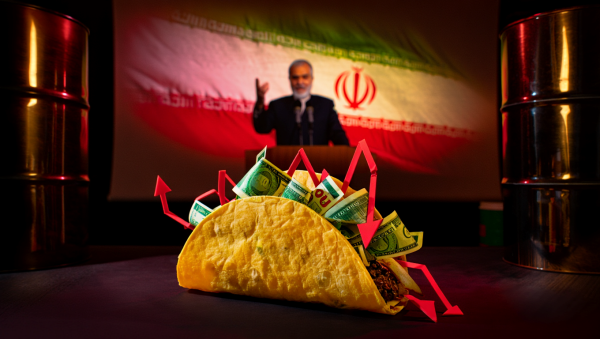
Iranian parliament speaker Mohammad Bagher Ghalibaf (모하마드 바게르 갈리바프) has sparked ripples in global financial markets by urging investors to use President Donald Trump’s policy announcements as a contrarian indicator.
BeInCrypto, a blockchain media outlet, reported on Saturday that he said on social media that Trump’s advance remarks should be read not as simple policy signals but as “profit-taking timing.” He proposed taking the opposite position, especially in energy markets.
The remarks are drawing attention as the so-called “TACO” (Trump Always Chickens Out) trade strategy, widely used on Wall Street, enters a shaky phase. The TACO strategy involves buying on market dips on the assumption that Trump retreats after talking up tough tariffs or military options. The strategy repeatedly worked through 2025, becoming something of a rule of thumb among investors.
But the situation has changed as tensions with Iran have risen. The market did not rebound even though Trump delayed an attack on Iranian energy infrastructure, and uncertainty instead grew. That is because participants no longer take it as a signal of de-escalation and have begun to read it as the possibility of further clashes. This has led to analysis that trust in the TACO strategy’s premise of an eventual retreat is weakening.
Macroeconomic indicators are also weighing on markets. The Federal Reserve Bank of Atlanta’s GDPNow lowered its U.S. first-quarter growth forecast from the 3 percent range to around 2 percent. At the same time, expectations for rate cuts have quickly receded, and markets are pricing in the possibility of higher rates for longer. The U.S. 10-year Treasury yield has also risen above 4.4 percent, raising overall tension across financial markets.
Ghalibaf’s remarks go a step further. He warned that financial institutions buying U.S. Treasuries could become military targets, raising direct geopolitical risk in the bond market. This is being interpreted as signaling a new risk phase in which financial markets and geopolitics are intertwined.
Experts say the situation is exposing the limits of existing investment strategies. The TACO strategy rested on the assumption that major trading partners such as China, the European Union and Canada have eased conflicts through negotiations. But Iran is maintaining a hardline stance and is not entering talks even after military strikes, leading to a flow that is entirely different from the past.
With Brent crude rising above $110 a barrel, instability in the energy market is widening. Concerns are also mounting about a blockade of the Strait of Hormuz, and markets are taking this not as a short-term event but as a structural change. In particular, if the U.S. 10-year yield breaks back above 4.5 percent, whether the White House responds on policy is emerging as a key variable.
BeInCrypto interpreted the situation as showing that a simple trading strategy based on Trump’s pattern of remarks may no longer be effective. It also said the impact of geopolitical risk on financial markets is expanding in a more direct and structural way, signaling the need for a broad recalibration of investment strategies.
 Jinju Hong
hongjj@d-today.co.kr
Jinju Hong
hongjj@d-today.co.kr