
Savings banks will be able to extend lending to mid-sized companies as well as small businesses.
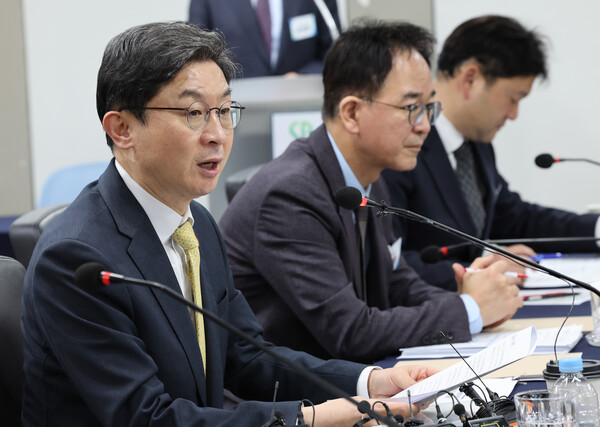
The Financial Services Commission held a policy meeting with chief executives on the sound development of savings banks on Tuesday afternoon at the Savings Bank Central Association building in Mapo-gu, Seoul, and unveiled its measures.
Financial Services Commission Chairman Lee Eok-won (이억원) stressed that savings banks should move away from a business structure focused on short-term profits and provide stable support for the real economy and local communities. He also said they should establish their role and identity as institutions for ordinary people’s finance, from hub regions to a nationwide level.
Under the plan, savings banks' main corporate lending targets will be expanded from small and medium-sized companies to include mid-sized firms with assets of 500 billion won or more.
Under the current Mutual Savings Bank Act, savings banks are required to maintain lending to individuals and small and medium-sized companies within their business areas at a certain level. Going forward, mid-sized companies will also be included in that lending ratio.
The commission will also push a plan to favor lending outside the capital region by raising the weighting for loans in capital-area business zones when calculating the loan-to-deposit ratio to 105 percent from 100 percent, and lowering the weighting for loans in non-capital business zones to 95 percent from 100 percent.
Large savings banks that meet certain soundness requirements will be allowed to handle check cards (debit) and mobile coupons (prepaid) on their own.
In addition, the commission will push to allow linked investment with online investment firms in savings banks' unsecured credit loans to sole proprietors, and to separate sole proprietor loan products within Sandol loans.
It will also raise some borrower-by-borrower lending limits for corporate and sole proprietor borrowers at mid- to large-sized savings banks, and ease rules that currently prohibit savings banks from running TV commercials during hours when children and teenagers can watch.
The commission also decided to revamp prudential and governance regulations in a more realistic way.
For large savings banks, it plans to introduce the bank-level Bank for International Settlements (BIS) ratio calculation method in stages. It will also introduce a differentiated ownership regulation system based on asset size, including setting limits on shareholdings by a single person at the level applied to regional banks, as well as asset soundness classification standards based on forward-looking debt service capacity (FLC) that will substantially assess credit risk in corporate lending. For small savings banks with sound financial health, it will ease the external audit cycle from quarterly to semiannual to reduce the burden.
The commission also plans to convert SB NPL Daebu, currently a non-performing loan management unit of the Savings Bank Central Association, into an asset management company to strengthen the industry's capacity to manage bad assets. It also plans to upgrade the monitoring system for savings bank deposits and overhaul liquidity management.
Lee said the plan is not a short-term response measure but the starting point of a structural shift aimed at enabling savings banks to secure mid- to long-term soundness and competitiveness. He said savings banks should build on it to develop into a trusted financial sector for all customers including businesses, households and local communities, with greater accountability and flexibility in supplying funds.
 Ji-young Lee
ljy@d-today.co.kr
Ji-young Lee
ljy@d-today.co.kr