
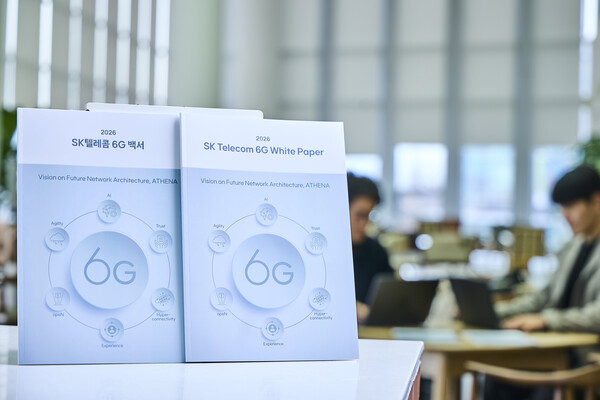
SK Telecom said on Feb. 23 it published its third 6G white paper, 'ATHENA', outlining a mid- to long-term network evolution strategy, and will showcase some related technologies at MWC26.
The new paper is an extension of SKT’s ongoing series of 6G white papers. In 2023, it introduced key requirements and technology trends needed for 6G mobile standardisation. Last year, it underscored the direction for communications infrastructure in the coming AI era.
In preparation for 6G commercialisation after 2030, SKT in the latest paper pointed to rapid changes in the communications environment, including increasingly sophisticated security threats and a shift in the network operations paradigm. Based on this, it presented a mid- to long-term network evolution strategy aimed at improving operational efficiency, innovating customer experience and achieving network monetisation.
SKT set out six directions as key pillars of its network evolution vision: AI integration into networks (AI-native), zero-trust security, converged infrastructure spanning 5G, 6G and satellite communications (ubiquitous), an open ecosystem, virtualisation-based flexibility (cloud-native), and maximising customer experience.
SKT defined the mid- to long-term network architecture to realise this vision as ATHENA and presented the structure and evolution direction across all areas of the network.
SKT’s radio access network will evolve into a structure in which AI identifies its own status and optimises operations, based on virtualisation and open interfaces. The core network and transport network will develop into a cloud-based structure in which AI automatically manages and controls traffic and abnormal situations.
Following the publication, SKT will showcase key related technologies at MWC26. It will exhibit various AI agents to be applied to networks, 'AI base station (AI-RAN)' technology that provides communications and AI services simultaneously, on-device AI-based antenna optimisation technology, and 'communications-sensing integration' technology that collects information on the surrounding environment through radio signals.
Ryu Tak-gi (류탁기), head of network technology at SKT, said the company will prioritise customer value amid uncertainty in the 6G era by combining AI, virtualisation, openness and zero-trust security. He emphasised that, from a perspective that looks ahead 10 years, it will lead the evolution of future communications infrastructure and create new growth opportunities.
 Jin-ho Lee
jhlee26@d-today.co.kr
Jin-ho Lee
jhlee26@d-today.co.kr