
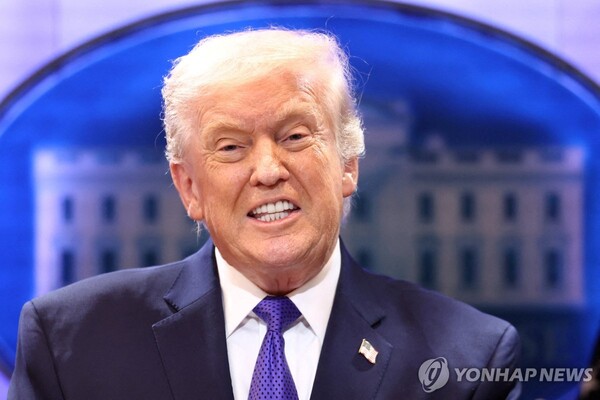
U.S. President Donald Trump said he would raise the newly imposed "global tariff" on the world from 10 percent to 15 percent, a day after a U.S. Supreme Court ruling that reciprocal tariffs were illegal.
The move was seen as showing his determination to maintain a high-intensity tariff policy by mobilising all alternative means despite the court setback.
Trump said on Truth Social on Feb. 21 (local time) that, as a measure taking immediate effect, he would raise the 10 percent Worldwide Tariff to the "maximum allowed" and "legally validated" level of 15 percent.
He also wrote that many countries around the world had "extorted" the United States for decades "without any retaliation (until I came along!)."
Trump said he made the decision based on a "thorough and detailed and complete review" of what he called the Supreme Court's "absurd, badly written, and extremely anti-American" tariff decision the day before.
He added that in the coming months, the Trump administration would determine and announce new and legally permissible tariffs, saying it would continue the "Make America Great Again" process, which he described as remarkably successful.
The U.S. Supreme Court ruled the day before that the reciprocal tariff measures Trump imposed on countries around the world were illegal under the International Emergency Economic Powers Act (IEEPA).
Trump then signed an executive order imposing a "10 percent global tariff" on the world under Section 122 of the Trade Act, saying he would use alternative means to maintain his tariff policy.
He soon said he would raise the global tariff rate to 15 percent, and follow-up steps such as additional executive orders are expected to follow.
Section 122 of the Trade Act grants the president authority to impose tariffs of up to 15 percent for up to 150 days to respond to balance-of-payments problems. To continue the measure after 150 days, Congress must approve an extension.
Trump also plans to use Section 232 of the Trade Expansion Act and Section 301 of the Trade Act to replace the invalidated reciprocal tariffs and other measures.
Section 232 of the Trade Expansion Act grants the president tariff authority if a relevant department investigation determines imports of certain items threaten national security, and it has already been used to impose tariffs on various items including automobiles and steel.
Section 301 of the Trade Act allows the president, after a period of notice and the collection of opinions, to take retaliatory measures such as tariffs against trading partners that engage in unfair and discriminatory trade practices against the United States.
Some point out that legal issues could follow Trump's new tariffs as well.
The Wall Street Journal reported there is debate among legal experts over whether the current U.S. trade deficit situation meets the requirements of Section 122 of the Trade Act.
Trump argues the U.S. trade deficit situation falls under Section 122's "fundamental international payment problem," but there are opinions that it is difficult to make that determination, the report said.
As a result, the WSJ noted that Trump's global tariff measures could also become embroiled in legal disputes.
Reuters also said Section 122 of the Trade Act had never been invoked before and could lead to additional lawsuits.
Reuters also said that applying Section 122 after 150 days would require congressional approval, and it viewed it as questionable whether Congress would accept it.
In a separate Truth Social post, Trump praised three Supreme Court justices who said in a dissent in the ruling the day before that his tariff policy was legal.
Trump wrote, "My new hero is Supreme Court Justice Brett Kavanaugh, and of course Justices Clarence Thomas and Samuel Alito are also included," adding, "No one doubts that they have the goal of 'Make America Great Again.'"
[Yonhap News Agency]
 Online Team
d-today@d-today.co.kr
Online Team
d-today@d-today.co.kr