
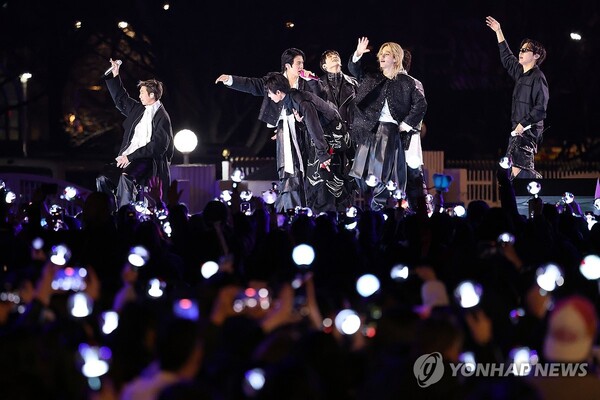
Netflix livestreamed BTS' Gwanghwamun comeback show in real time, but some said buffering and low video quality need to be improved.
BTS held a concert at Gwanghwamun Square in Seoul on March 21 to mark the release of its new album, "Arirang (ARIRANG)." Netflix exclusively livestreamed it to more than 190 countries and regions worldwide. Netflix has more than about 300 million paid subscribers. Netflix said 18.4 million viewers worldwide watched the performance that day.
It also said the show made weekly top 10 lists in 80 countries and ranked No. 1 in 24 countries.
Some also voiced disappointment over broadcast quality. On X and fan communities, users complained: "The members are already singing the next line, but the subtitles are still on the previous lyrics," and, "Subtitles only appear after the lyrics end." Criticism was especially strong that even pre-prepared lyric subtitles were out of sync. Some also complained the camera frequently showed the audience instead of BTS members.
The reporter also confirmed screen-freeze issues. During the final song of the main performance, "Dynamite," the video stopped and only audio was transmitted for about 5 minutes. The reporter watched on a TV under Netflix's Standard plan, priced at 14,500 won per month, and there were also video quality drops early in the show.
Some say Netflix's livestreaming method exposed structural limits. Terrestrial broadcasters, which have led live broadcasts, use a multicast structure that sends a signal once so all receivers get it simultaneously. It has the advantage that quality does not degrade even as the number of concurrent viewers rises.
Netflix, by contrast, uses a unicast method that establishes an individual connection between the server and each viewer. It is advantageous for handling security and digital rights management (DRM), applying adaptive bitrate (ABR) for each user, and implementing interactive functions such as rewind and pause.
The problem comes when concurrent viewers surge. Unlike video on demand, live broadcasts cannot store and distribute content in advance, reducing the efficiency of content delivery networks (CDNs). If tens of millions pile in at once, data transmission volume can exceed the network's processing limits and video data may not arrive in time, causing buffering. ABR automatically lowers video quality to reduce data volume, but if the buffer cannot cope even at low quality, video can freeze or only audio may play.
Netflix says it has expanded infrastructure, including increasing server and network capacity, to handle more concurrent connections. For this broadcast, it worked with Amazon Web Services (AWS) to use more than 6,000 global locations and more than 18,000 servers. It also operated a real-time monitoring system that analyzes up to 38 million system events per second.
Even so, as quality issues recur, some skepticism is emerging that OTT services cannot fully replace terrestrial broadcasters in live broadcasts. A South Korean broadcaster official said, "Subtitle delays or camera-angle issues may seem minor, but they stem from direction that lacks understanding of the performing artist," adding, "As much as technology, content direction capability is also key to live broadcasts."
A telecommunications industry official said, "In the live broadcast arena, there are practical limits to replacing radio waves with internet networks," adding, "Radio waves are dedicated broadcast transmission infrastructure whose stability has been verified over decades."
LIVE STRATEGY TO CONTINUE
Netflix's push to strengthen live programming remains unchanged. Netflix currently holds global rights to WWE, exclusive U.S. rights to the FIFA Women's World Cup in 2027 and 2031, U.S. rights to MLB, and Japan rights to the World Baseball Classic (WBC). On March 26, it plans to livestream the MLB regular season opener between the New York Yankees and the San Francisco Giants across the United States. The WWE RAW broadcast deal is worth $5 billion over 10 years, about 6.84 trillion won.
Co-CEO Greg Peters (그렉 피터스) said, "We are strengthening our live event strategy, not sports broadcasting," adding, "We are continuing to learn and try."
Netflix also signaled clear intent to expand livestreaming of K-pop concerts. Brandon Riegg (브랜든 리그), Netflix vice president of nonfiction series and sports, said at a media briefing on March 20, the day before the concert, "There are a few discussions under way right now related to livestreaming Korean events," adding, "We will continue to expand livestream events and infrastructure investment."
 Seulgi Son
sageson@d-today.co.kr
Seulgi Son
sageson@d-today.co.kr