
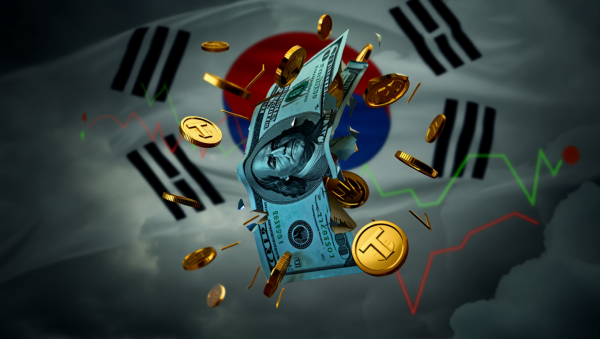
As the won’s value slides and demand for dollars surges, South Korea’s crypto market is seeing an unusual phenomenon in which Tether (USDT) is trading cheaper than the dollar.
On March 23, local time, the won-dollar exchange rate in Seoul’s foreign exchange market rose as high as 1,511.8 won intraday, its highest level since March 2009, blockchain media outlet BeInCrypto reported. The dollar’s strength intensified as investors sought safe-haven assets in the aftermath of the Iran war.
But moves in South Korea’s crypto market differed from the usual pattern. On South Korean crypto exchange Upbit, USDT traded at about 1,503 won, about 0.5 percent below the spot won-dollar rate. Typically, a weaker won leads domestic investors to buy USDT as a dollar substitute, creating a premium, but that pattern broke this time.
The shift is seen as a result of dampened speculative sentiment amid expanding geopolitical risks. Iran’s blockade of the Strait of Hormuz is pushing up oil prices and adding inflation pressure, and volatility is rising in the local stock market as foreign investors net sell KOSPI shares. In the past, when a weaker won coincided with crypto volatility, domestic retail investors tended to buy USDT and move into bitcoin (BTC) and altcoins, but this time preferences for actual dollars and dollar-denominated assets have increased, weakening demand for USDT.
As a result, a “USDT discount” has emerged in South Korea’s crypto market, and it is interpreted as a sign that the crypto market is not joining the safe-haven preference seen in the traditional foreign exchange market. U.S. President Donald Trump issued a tough warning to Iran over the Strait of Hormuz and then partly held back the possibility of military action, but Tehran is still maintaining a hardline stance, so pressure for won weakness could continue for the time being.
This “USDT discount” highlights that fund flows in South Korea’s crypto market have changed from the past during periods of won weakness. As stablecoins no longer function as an immediate dollar substitute, the view is gaining support that investors’ risk-off funds are moving into actual dollars and traditional assets. The market is watching whether the price distortion will persist depending on future exchange rate moves and changes in the Middle East situation.
 Yoonseo Lee
yslee@d-today.co.kr
Yoonseo Lee
yslee@d-today.co.kr