
[Digital Today reporter Lee Ho-jung] “There are no hit new titles, but they take tens of billions of won in pay and still get reappointed. I don’t understand why.”
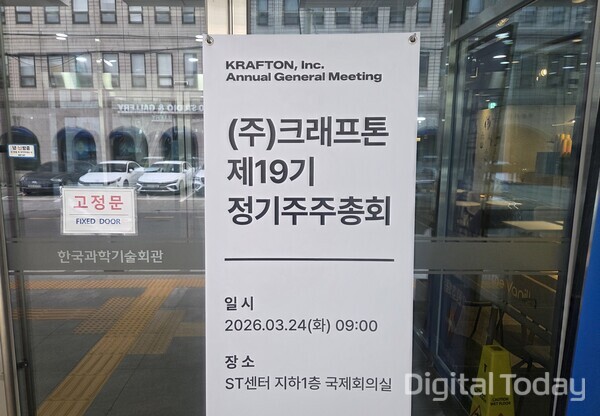
A shareholder made the remark at Krafton’s 19th annual general meeting of shareholders on March 24. It was a meeting to confirm record-high results, but the atmosphere was tense. With the share price stuck in the 230,000 won range, less than half the initial public offering price of 498,000 won, the agenda included proposals to reappoint CEO Kim Chang-han (김창한) and Chairman Jang Byung-gyu (장병규).
With 74.9 percent of voting shares represented, the meeting approved all items as proposed, including approval of financial statements, approval of a 20 billion won cap on directors’ remuneration, partial amendments to the articles of incorporation, appointment of inside and outside directors, and approval of plans to hold and dispose of treasury shares. After the meeting, a separate Q&A session followed, with about 30 minutes of questions and answers on management issues.
◆Shareholders criticise reappointment, pay and weak new titles
Shareholder questions focused on whether Kim’s reappointment was appropriate. Dissatisfaction built up after disclosure of pay in the tens of billions of won amid a share price below half the IPO price and weak performance of new titles. One shareholder acknowledged record-high results, share buybacks and cancellations, and personal share purchases, but said the promised expansion of the PUBG IP was slow and that limits over the past three years were clear when considering lawsuit risks involving Inzoi and Subnautica. The shareholder asked the company to speak frankly about achievements and shortcomings during the last term.
Han So-young (한소영), head of the HR division, said the disclosed pay combines incentives reflecting past performance and stock-based compensation (RSU) in addition to base salary for the year, making simple comparisons difficult. On the reappointment decision, she said management continuity was important to carry out mid- to long-term strategy in a stable way. She said the company believed it was right to give him the opportunity to take responsibility through the end so that strategies prepared so far, including securing a pipeline of more than 20 new titles and expanding AI investment, can translate into results.
Kim said he felt fully responsible for the current share price and level of corporate value, adding that the share price did not fall because of a decline in performance. He cited as an achievement that PUBG has established itself as a long-term franchise IP rather than a single game. On shortcomings, he said it was hard to refute criticism that the company failed to discover a new IP within three years. He added that Inzoi and Mimesis each selling more than 1 million copies was an achievement that ranks within 0.2 percent of games released on Steam overall. He said that if he is reappointed, he believes the strategies pursued during his term can produce results.
Shareholders also questioned why Chairman Jang did not attend the meeting at which his own reappointment was on the agenda. At the meeting, the issue of why he did not stand before shareholders in person was seen as larger than whether his reappointment was necessary. One shareholder said it was hard to understand that the person concerned was absent from the agenda for his own reappointment, and asked why he should remain on the board, unlike a global trend of founders stepping away from the front line of management.
Han said it was due to an unavoidable schedule, adding that from 2027 the company plans to hold a hybrid electronic shareholders’ meeting, which would enable online attendance. On Jang’s role on the board, she said he contributes to decision-making on mid- to long-term strategic direction and key issues rather than day-to-day management, and that the board judged that role to be important.
◆Post-meeting Q&A reviews causes of weak share price and five-year plan
Questions on the share price continued during the Q&A session held after review of the agenda items. One shareholder said the share price did not respond even though the company increased dividends and bought back shares, adding that only Krafton was moving separately while the KOSPI was rising.
CFO Bae Dong-geun (배동근) said management shared the view that the share price was weak relative to fundamentals and felt frustrated. He said the market seemed to place more importance on how visible the next growth engine is than on PUBG’s current performance. With about 20 lineups being developed simultaneously, he said the market would also confirm it when visibility of new titles becomes concrete. He added that changes in which sectors are in the spotlight over time are also an area management cannot control.
Asked whether management pay is linked to the share price, Han said performance bonuses are set step by step based on performance metrics such as revenue and operating profit, while long-term performance is paid in the form of RSUs. She said RSU vesting conditions include the company’s own share-price increase rate and whether it achieves a target market capitalisation, and also reflect relative share-price increases versus the overall market.
Asked about the status of the five-year mid- to long-term plan announced at last year’s meeting, Kim said PUBG would account for more than 60 percent of targeted revenue and that this part was currently progressing smoothly. On new IP, he said major IP does not come out every year, and that new titles will undergo market validation in sequence from the second half of this year. On the share price, he said it is true there are areas the company cannot control, but asked shareholders to trust the company and watch.
Shareholders also asked about the background to management’s disclosed purchases of company shares ahead of the meeting, including about 5 billion won by Kim and about 10 billion won by Jang. Kim said he wanted to show through action his conviction in the company’s future value by using an amount greater than the pay he received last year to buy shares, based on a 판단 that the current share price is undervalued. On Jang’s purchase, Bae said it was meant to show support for the five-year plan and its direction.
Other questions covered “Project Windless,” a game based on the original work “The Bird That Drinks Tears.” Kim said it received more interest than expected at Sony’s State of Play reveal and that reactions in the West were positive. He said the game builds a new narrative against the backdrop of a process, set 1,500 years before the original work, in which a hero king unifies the continent. He did not disclose a specific release date.
 Lee Ho-jung
lhj@d-today.co.kr
Lee Ho-jung
lhj@d-today.co.kr