
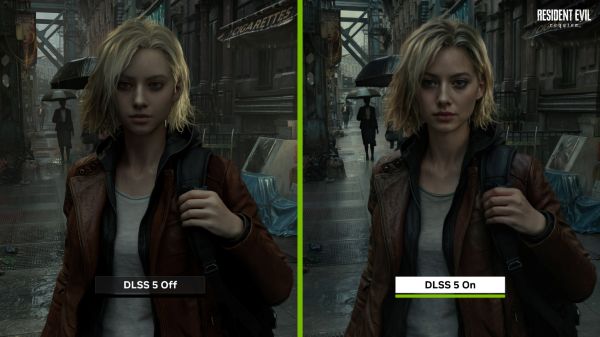
As Nvidia unveiled its next-generation upscaling technology, DLSS 5, at GTC 2026, a fierce backlash has erupted among gamers. On March 21, IT outlet TechRadar said expectations and concerns over DLSS 5 were rising at the same time.
DLSS 5 is a technology that significantly strengthens lighting effects through real-time neural rendering. Nvidia stressed it could boost the realism of game graphics, but criticism spread rapidly across online communities immediately after the announcement. On Bluesky, Reddit and X, formerly Twitter, users posted reactions saying DLSS 5 damages the mood of original graphics and looks overly like artificial intelligence (AI).
The strongest backlash has focused on the visual results in sample images and videos using DLSS 5. Many gamers said the original graphics looked better in before-and-after comparisons and voiced discomfort with DLSS 5’s excessive lighting and color rendering. They also said character faces looked unrealistic and that scenes were too bright and sharp, with overly high saturation that stripped away a natural feel.
Some users criticised it as “AI slop”, or digital trash. Nvidia explains DLSS 5 does not newly create in-game graphic elements like generative AI, but instead precisely applies lighting effects on top of existing graphics. Some gamers, however, say it feels as if a character’s overall impression has changed, beyond mere lighting correction.
A prominent example cited is “Resident Evil Requiem”. Critics say the original’s dark and rough horror atmosphere noticeably weakened after DLSS 5 was applied. Some also criticised the lighting changes for altering impressions of both characters and backgrounds, undermining the horror direction and artistic orientation the game originally intended. They raised the issue of whether it interferes with a game’s aesthetics itself.
DLSS 5’s high hardware requirements are also controversial. Two RTX 5090 graphics cards were used in an early demo, prompting some to raise concerns that DLSS 5 could be an overly demanding technology. They questioned whether it could run smoothly on consumer graphics cards if even the latest flagship GPUs must be used in pairs. This has also fuelled suspicion that Nvidia is effectively trying to drive sales of new graphics cards.
Some argue it is too early to draw conclusions from those concerns. Nvidia has explained that the final commercial version of DLSS 5 will run on a single GPU. It said the current demonstration is only an early preview, largely a demo for validating the technology. Some also mention the burden could be reduced at resolutions other than 4K. Still, some say it remains uncertain how much performance it can deliver on products at or below the RTX 5080, or whether it will effectively be aimed at the next-generation RTX 6000 series.
Such controversy has repeated in the past. When first unveiled, DLSS 1 drew fierce criticism for blurry screens and various glitches, but market assessments quickly reversed after Nvidia improved quality by introducing temporal upscaling in DLSS 2. DLSS 3 was also initially caught up in a “fake frames” controversy, but after DLSS 3.5 the frame generation technology stabilised and it is now generally accepted.
As a result, the market sees a strong possibility that DLSS 5 will also improve through updates and follow-on versions even if it faces backlash early in its release. Some expect that many of the issues raised now could be largely resolved in later models paired with an official version or next-generation GPUs.
Ultimately, some analysis says the success or failure of DLSS 5 depends not only on technical completeness, but on how Nvidia refines it in a way that respects a game’s mood and artistic direction. The backlash is strong, but as with DLSS 1 and DLSS 3, the assessment could change over time. Attention is focused on whether Nvidia can again turn criticism into persuasion.
 Yoonseo Lee
yslee@d-today.co.kr
Yoonseo Lee
yslee@d-today.co.kr